
On this page (8 sections)
House edge is the statistical advantage a casino holds on a given game, expressed as the average percentage of wagered money it keeps over a large number of rounds. It is a long-run average, not a promise about any single bet.
House edge vs RTP: same number, opposite direction
The two figures you see quoted for any game — house edge and RTP — describe the same fact from two directions. RTP (return to player) is the share of wagered money a game pays back on average. House edge is what's left over. The relationship is fixed:
The one formula worth memorising
House edge = 100% − RTP. A game with 98% RTP has a 2% house edge. A game with 96% RTP has a 4% house edge. There is no game where both numbers are favourable to the player — they always sum to 100%.
Marketing tends to lead with whichever number sounds better. A game advertised on its "96% RTP" and a game advertised on its "4% house edge" can be the exact same game. Learning to convert between the two instantly is the fastest way to stop being swayed by which figure a page chose to print in large type.
Worked example: what a 2% edge costs on paper
Take a hypothetical game with a 2% house edge — illustrative numbers only, not tied to any specific title. Every $100 wagered on it, averaged over enough rounds, returns $98 and keeps $2. That $2 is the expected cost of the bet, not the guaranteed outcome of any one spin or hand.
| Turnover wagered | Edge | Expected cost (average, long run) |
|---|---|---|
| $100 | 2% | $2 |
| $1,000 | 2% | $20 |
| $10,000 | 2% | $200 |
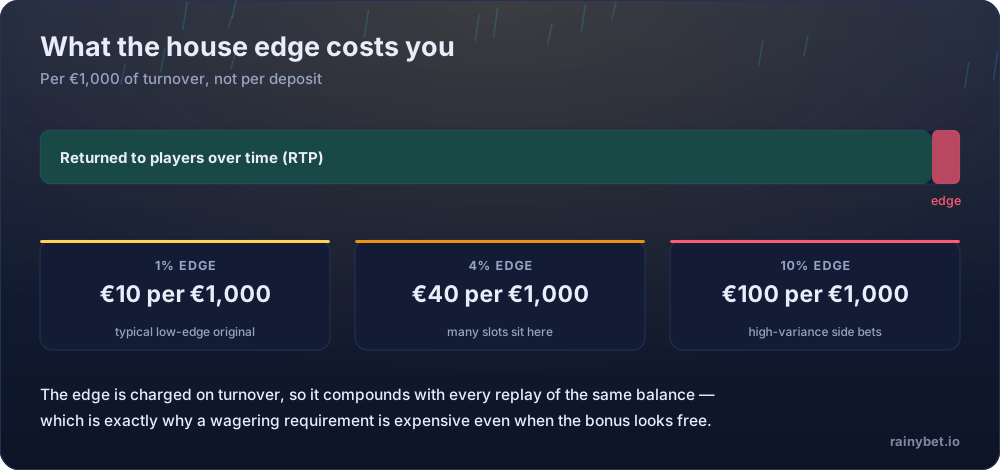
Notice what is doing the work in that table: the turnover figure, not the edge. The edge stayed fixed at 2% in every row. It's the amount wagered that decided how much the edge cost in absolute terms — which is the exact idea the next section builds on.
Turnover, not your deposit balance
Turnover is the total amount wagered across every individual bet in a session, which can be many times larger than the deposit that funded it if the same balance gets wagered repeatedly.
This is the single most misunderstood idea in casino maths. People read "2% house edge" and assume it means losing 2% of their deposit. It doesn't. It means losing an average of 2% of everything they wager — and a $100 deposit can easily generate $1,000, $5,000 or more in turnover if it gets bet, won back, and bet again.
A quick illustrative example: deposit $100, bet it on a game with a 2% edge, win some back, keep playing with the winnings, lose some, keep playing again. By the end of an hour you might have wagered $2,000 in total turnover through that original $100, even though your balance never exceeded a few hundred dollars at any point. The edge applied to all $2,000, not to the $100 you started with.
Why replaying the same balance compounds the cost
Follow that logic one step further and the real risk becomes visible. Every time a balance gets wagered again, it generates fresh turnover, and fresh turnover is where the edge is charged. Replaying the same money is not free just because it's "the same dollars" — each replay is a new round of exposure to the edge.
| Deposit | How many times it gets replayed | Approximate turnover | Expected cost at 2% edge |
|---|---|---|---|
| $100 | 1× (bet once, stop) | $100 | $2 |
| $100 | 5× (win, rebet, repeat) | $500 | $10 |
| $100 | 20× (a long grinding session) | $2,000 | $40 |
The trap this explains
A losing session doesn't feel like "losing $40 on a $100 deposit." It feels like a long string of small bets, most of which felt close to even. That's exactly how compounding turnover hides itself — the cost accumulates in increments too small to notice individually. Our bankroll management guide covers how to cap turnover with session limits before this becomes a problem.
Rakeback is a discount on the edge, never a reversal
Rakeback is a share of the house margin a player's turnover has already generated, paid back to that player. It reduces the effective cost of playing; it does not remove the underlying edge.
Continue the worked example. $10,000 of turnover at a 2% edge generates $200 of expected margin. Say a rakeback programme returns 20% of that margin to the player — a hypothetical rate, not a specific brand's published figure. That's $40 back, leaving a net expected cost of $160 on the same $10,000 of turnover.
| Turnover | Edge | Expected margin | Rakeback rate (hypothetical) | Amount returned | Net expected cost | Effective edge |
|---|---|---|---|---|---|---|
| $10,000 | 2% | $200 | 20% of margin | $40 | $160 | 1.6% |
The effective edge dropped from 2% to 1.6%. It did not drop to zero, and it did not flip negative. That's the whole idea in one sentence: rakeback is a discount on the house's advantage, structured as a rebate on margin already generated, not a reversal of the advantage itself. Anyone marketing a rakeback rate as "beating the house" is describing a smaller loss as a win.
Do the sum with your own numbers
Take your realistic monthly turnover, multiply by the edge of the games you actually play, then apply a rakeback rate if one applies to your account. Our EV and Kelly calculator and wagering calculator run this with your own figures instead of the illustrative ones above.
How common games compare
As commonly implemented across the industry, house edges vary a lot by game family. These are typical published figures for the category, not a claim about any single operator's exact build of a game:
| Game type | Typical edge (as commonly implemented) | Why it sits there |
|---|---|---|
| Blackjack, perfect basic strategy | Often under 1% | Player decisions materially change the outcome, unlike pure chance games |
| Craps, pass line only | Around 1.4% | One of the simplest bets on the table, with few side wagers dragging the average up |
| European roulette (single zero) | About 2.7% | One zero pocket gives the wheel its edge |
| American roulette (double zero) | About 5.3% | A second zero pocket roughly doubles the edge of the European wheel |
| Slots | Roughly 2%–10%+, wide variation | Edge is set per title and can differ enormously between machines |
| Simple provably fair games (crash, dice style) | Often around 1%–2% | Typically a fixed, published percentage built into the round |
The gap between a 1% game and a 5% game isn't cosmetic. Run the same $10,000 turnover through both and the expected cost moves from $100 to $500 — a $400 difference for choosing one game over another with identical stakes and identical session length. Our crash simulator and Mines simulator let you watch edge play out over volume without risking anything.
Turning this into a decision before you deposit
None of this is a strategy for beating the edge — there isn't one. It's a way to read any bonus code, rakeback rate or promotion with the right question in mind: does this change my turnover, my edge, or neither? A deposit match changes neither by itself. A rakeback rate discounts the edge slightly. Nothing changes the fact that turnover, not deposit size, is what the edge is actually charged against.
- Read any advertised RTP or edge figure and immediately convert it to the other — it forces you to notice which number a page chose to hide
- Estimate your own realistic turnover for a session, not just your deposit, before judging how much a bonus or rakeback rate is really worth
- Treat rakeback as a partial refund on cost, never as a reason to increase how much you play
- Compare our Rainbet, Stake and Roobet reviews on this exact point — how each brand's rakeback or bonus mechanic interacts with turnover rather than deposit size
Licence, geo-restrictions and playing safely
Licensing. Access is blocked in a number of countries and US states, and the list is maintained by the operator rather than published as a stable document. The current restricted list and licence details live on the operator’s own terms page — read them before you register.
Your side of it. Crypto casinos settle fast, which is exactly what makes them easy to overplay. Before your first deposit at these operators, set a deposit cap and a session timer in the account settings — not in your head.
- Deposit limits and self-exclusion tools live in account settings, not support chat
- A losing session is not a signal to raise the stake — it is a signal to stop
- Bonus turnover targets are not a reason to keep playing past your limit
- Free, confidential help: BeGambleAware and Gambling Therapy
Frequently asked questions
What is house edge in simple terms?
House edge is the average share of every bet a casino keeps over a large number of rounds, expressed as a percentage. A 2% edge means that, averaged across thousands of bets of the same size, the casino keeps roughly 2 cents of every dollar wagered. Any single bet can still win or lose in full — the edge only describes the long-run average.
How is house edge different from RTP?
RTP (return to player) and house edge describe the same number from opposite directions. If a game pays back 98% of wagered money on average, its RTP is 98% and its house edge is the remaining 2%. House edge = 100% minus RTP, always.
Does house edge apply to my deposit or to my turnover?
Turnover, not your deposit. Turnover is the total amount you wager across every bet, which can be far larger than your deposit if you replay the same balance repeatedly. A $100 deposit that gets wagered ten times over has $1,000 of turnover, and the edge applies to that $1,000.
Why does replaying the same balance cost more than the deposit itself?
Because the edge is charged every time money is wagered, not once per deposit. Each replay is a fresh round of turnover, so a small balance recycled many times can generate expected losses larger than the original deposit — not because the edge changed, but because it was applied more times.
Does rakeback cancel out the house edge?
No. Rakeback returns a slice of the margin the edge already generated — it lowers the effective cost of playing but never removes the edge itself. A game with a 2% edge and 20% rakeback on that margin still has a positive edge in the house's favour, just a smaller one.
Which casino games have the lowest house edge?
As commonly implemented, blackjack played to perfect basic strategy and the pass line bet in craps sit among the lowest, often under 1%. European roulette's single-zero wheel typically runs close to 2.7%, American roulette's double-zero wheel closer to 5.3%, and slots vary widely, often landing between 2% and 10%+ depending on the title.
Can house edge guarantee what happens in one specific session?
No. Edge is a statement about the average over a large number of rounds, not a prediction for any single session. Variance means a short session can finish well above or well below what the edge alone would suggest — the edge only becomes reliable as a predictor over volume.