

On this page (9 sections)
Play money only — read this first
This simulator runs on play money that lives only in your browser tab. It cannot predict a real round, results here cannot be transferred to a real account, and no auto-cashout target or betting pattern overcomes a negative expected value. It exists to demonstrate the crash-point maths, nothing more.
Play the simulator
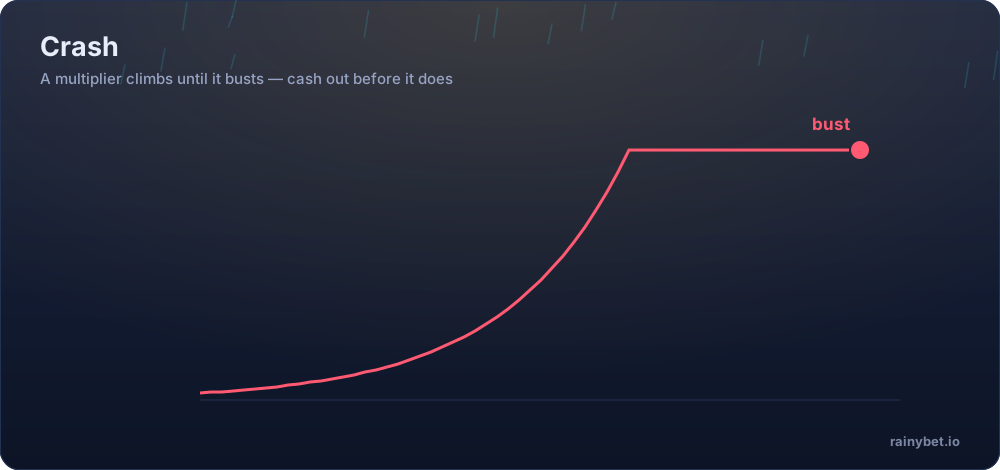
This Crash simulator animates a multiplier rising from 1x until it hits a randomly drawn bust point. Set an auto-cashout target, run single rounds or a 1,000-round batch, and watch how the house-edge input reshapes every outcome — all with play money.
Set your auto-cashout target, then click “Run round”.
The inverse-CDF formula behind the bust point
We want a distribution where the probability of the multiplier reaching at least x is proportional to 1/x — that shape is what makes every cash-out target equally fair. Formally, we want P(X ≥ x) = (1−edge)/x, which gives a cumulative distribution F(x) = 1 − (1−edge)/x.
To sample from it, draw a uniform random number p between 0 and 1 and solve F(x) = p for x:
x = (1 − edge) / (1 − p)
That is the inverse-CDF this simulator runs on every round: draw p, compute x, floor it to the nearest cent, and never let it fall below 1.00x. Set the house-edge input to 1% and the formula becomes 0.99 / (1−p); set it to 4% and it becomes 0.96 / (1−p) — a smaller numerator shrinks every possible bust point proportionally.
We tested this against a two-million-round simulation
Running this exact formula at a 1% edge and cashing out every round at a fixed 3x produced an average return of 0.989 per unit staked across two million simulated rounds — within rounding noise of the 0.99 the edge input predicts. The same test at 4% edge and a 10x target returned 0.958, against a 0.96 prediction. The formula does what it says.
Why every cash-out target converges on the same edge
Set the target to 1.5x and you win often, for a small payout each time. Set it to 20x and you win rarely, for a huge payout on the rare round that gets there. Run either strategy for a thousand rounds in the batch mode and both settle near the same average return — the one set by the house-edge input, not by the target you picked.
This is the same shape of result our Dice simulator demonstrates with a much simpler formula — different mechanic, same underlying principle: the edge lives in the distribution, not in any choice you make on top of it.
Batch mode: what 1,000 rounds actually looks like
A single round of Crash tells you almost nothing about the maths behind it — you either won or you didn't. The batch button runs your current auto-cashout target one thousand times in an instant and reports three numbers: how often it hit, the longest run of consecutive misses along the way, and where a fixed starting bankroll ends up after wagering the same amount every round.
Watch the losing streak number, not just the win rate
At a 2x target with no edge, the true win chance is roughly 50%, but a sequence of six or seven losses in a row inside a thousand rounds is genuinely common — not a bug, not bad luck, just what a fair coin-flip-shaped distribution produces at that sample size. Run the batch a few times in a row and compare the streak length each time.
How to use this without fooling yourself
Four ways to get something real out of a play-money round
- Run the batch mode at your usual target before playing a single manual round.
Where people trip up: Seeing the long-run win rate first stops a lucky or unlucky short manual session from distorting your sense of what the target actually does.
- Change the house-edge input, then re-run the exact same batch.
Where people trip up: Watching the win rate stay put while the final bankroll shifts is the clearest way to see that the edge, not the target, is what changed.
- Try a very low target and a very high target back to back in batch mode.
Where people trip up: Both should land near the same average return at the same edge setting — if they look wildly different, you're looking at a short-run fluctuation, not a real gap.
- Use the manual mode to practise clicking “cash out” before the auto-target, then compare the result to letting auto-cashout run.
Where people trip up: This is the cleanest way to feel why a pre-committed number is harder to talk yourself out of mid-round than a live decision.
Crash simulator vs. real-money Crash
| This simulator | Real-money Crash (e.g. Roobet, BC.Game) | |
|---|---|---|
| Funds at risk | None — play money only | Real deposited funds |
| Crash-point source | Inverse-CDF formula shown in full above | Provably fair server seed — exact constants verified per round, not published as a fixed table |
| Fairness verification | Not applicable — no real wager exists to verify | Commit-reveal provably fair, checkable per round |
| Purpose | Teach the maths and the feel of variance | Real wagering with real risk and real rakeback or cashback accrual |
Once the maths above is clear, our Roobet Crash guide and BC.Game Crash guide cover the real mechanic, provably fair verification and the bonus terms attached to each. The code itself:
Honest pros and cons of practising here
What works about this offer
- Zero financial risk while you learn how the bust-point distribution behaves
- Batch mode compresses a thousand rounds into the time one real round takes
- House-edge input isolates the operator's margin from the shape of the curve
- Manual mode lets you feel the near-miss pull with nothing actually at stake
What to weigh up first
- Not connected to any specific operator's exact published crash-point constants
- A winning batch run here proves the formula, not that a real session will match it
- Cannot replicate the psychological pressure of a real balance rising and falling
- Provably fair verification does not apply, since no real wager exists to verify
Licence, geo-restrictions and playing safely
Licensing. Access is blocked in a number of countries and US states, and the list is maintained by the operator rather than published as a stable document. The current restricted list and licence details live on the operator’s own terms page — read them before you register.
Your side of it. Crypto casinos settle fast, which is exactly what makes them easy to overplay. Before your first deposit at Roobet, set a deposit cap and a session timer in the account settings — not in your head.
- Deposit limits and self-exclusion tools live in account settings, not support chat
- A losing session is not a signal to raise the stake — it is a signal to stop
- Bonus turnover targets are not a reason to keep playing past your limit
- Free, confidential help: BeGambleAware and Gambling Therapy
Frequently asked questions
How does this simulator decide where a round crashes?
It draws a crash point from an inverse-CDF formula: pick a random number p between 0 and 1, then the crash point is (1 − edge) / (1 − p), floored to the nearest cent and never allowed below 1.00x. That single formula produces the same expected return at every possible cash-out target.
Why does cashing out at 1.5x or 10x give the same expected value?
Because the crash-point distribution is built specifically so that the chance of reaching any multiplier x is proportional to 1/x. A high target wins rarely but pays a lot; a low target wins often but pays little. The two effects cancel out to the same long-run average, set by the house-edge input.
What does the house-edge input actually control?
It scales the entire crash-point distribution down by a fixed percentage. At a 1% edge, the long-run expected return from any fixed cash-out strategy is 99% of what was staked; at 4% edge, it is 96%. Raising the input lowers every strategy's expectation by the same amount.
Does auto-cashout change my odds?
No. It removes reaction time from the equation — the round exits automatically at your target the instant it is reached, if it is reached before the bust point. The underlying crash-point distribution, and therefore the expected value, is identical with or without it.
What does the 1,000-round batch mode actually show?
It runs a fixed auto-cashout target one thousand times instantly, with no animation, and reports the win rate, the longest losing streak encountered, and the final play-money bankroll. It is the fastest way to see what your chosen target does over a realistic sample instead of the ten or twenty rounds a real session usually allows.
Is a long losing streak in the batch mode a sign something is wrong?
No — it is the expected behaviour of a negative-expectation game played many times. Run the batch a few times at the same settings and the streak length will vary round to round while the win rate stays close to the same value each time.
Is this the same crash-point formula real crash games use?
It is the general inverse-CDF construction that produces a house edge independent of cash-out target, which is the standard shape behind provably fair crash games. Specific operators may adjust constants or add extra rules that are not published as fixed figures — check the game's own provably fair verification for the live constants in use. See our Roobet Crash guide for the real mechanic and its provably fair verification.