
On this page (9 sections)
Read this before you click anything
Every simulator on this site runs on play money only. No result carries over to a real account, no session here changes a real house edge, and no sequence of outcomes predicts what a live game will do next. There is no staking pattern, cash-out rule or bomb count that turns a negative-expectation game into a positive one — these tools exist to show you variance honestly, not to find you an edge that does not exist.
What a casino simulator actually is
A casino simulator is a free, browser-based tool that reproduces the mathematical model behind a casino game — its odds, its multiplier formula, its payout curve — using play money, with no account, deposit or withdrawal involved at any point.
That is the whole idea, and it is worth being precise about it. A simulator is not a leaked version of a real casino's game engine, not a hacked demo, and not a way to see what a live round is 'about to do'. It is a small, transparent maths model we built and show you the formula for, running entirely in your browser.
Every number a simulator produces comes from a documented formula on that simulator's own page — a combinatorial product for Mines, an inverse-CDF draw for Crash, a binomial distribution for Plinko, a fixed ratio for Dice. Nothing is hidden, and nothing is tuned to look better than the maths actually is.
The same idea now covers table games too. Our roulette simulator spins a genuine 37-pocket European wheel and lets eight different bet types converge on the same 2.70% edge; the blackjack simulator deals real hands from a 6-deck shoe and shows a live basic-strategy hint for every decision; the baccarat simulator runs the correct third-card draw rules and checks Banker, Player and Tie against their true theoretical frequencies; and the slot machine simulator discloses its entire paytable and shows the arithmetic behind a configured 96% RTP in full. Beat your own bankroll on any of the four and it's saved to our play-money leaderboard, stored only in your browser.
What these tools can teach you
Three things, reliably, and none of them are predictions:
- What variance actually feels like. A bet with a genuinely fair long-run average can still lose ten, twenty, even fifty times in a row over a short sample. Reading that sentence and watching it happen in front of you land very differently.
- How a payout curve is built. Mines shows a multiplier compound reveal by reveal; Plinko shows a bell-shaped bucket distribution; Dice shows a straight ratio. Seeing the shape makes the underlying maths concrete instead of abstract.
- Why moving a slider never moves the edge. Every simulator here exposes a house-edge input specifically so you can watch bomb counts, cash-out targets, risk levels and roll targets all reshuffle variance while the expected value stays exactly where the edge input put it.
What they cannot do
The part every casino review site should say plainly and rarely does
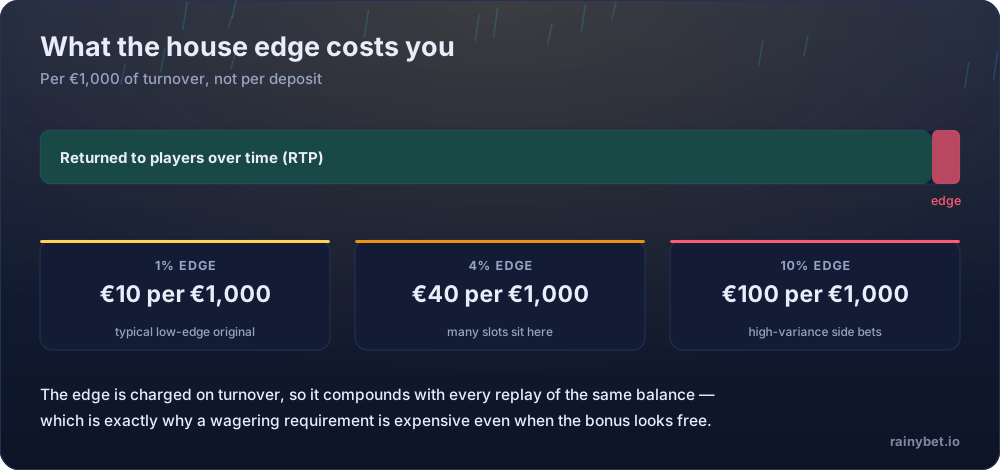
A simulator cannot predict a live round, cannot reveal a pattern in a provably fair random number generator, and cannot be used to develop a staking system that beats a negative expected value. If a game has a house edge, every betting pattern applied to it converges to that same edge over enough rounds — changing bet size, target or timing changes the variance of the ride, never the destination.
This is not a disclaimer we add reluctantly. It is the actual maths. A house edge is a property of the payout table, not of any sequence of bets placed against it. No amount of practice, on our tools or anywhere else, changes that relationship.
The eight simulators
| Simulator | What it models | Try it |
|---|---|---|
| Mines | Grid reveals, combinatorial multiplier maths, bomb-count risk | Mines simulator |
| Crash | Rising multiplier, inverse-CDF crash point, auto-cashout, batch mode | Crash simulator |
| Plinko | Binomial ball-drop distribution, risk-weighted payout buckets | Plinko simulator |
| Dice | Roll-under odds, fixed edge-to-payout ratio across every target | Dice simulator |
| Roulette | 37-pocket European wheel, eight bet types, one fixed 2.70% edge | Roulette simulator |
| Blackjack | Hit, stand, double and a live basic-strategy hint | Blackjack simulator |
| Baccarat | Correct third-card rules, Banker commission, real outcome frequencies | Baccarat simulator |
| Slot machine | A disclosed paytable normalised to a configured 96% RTP | Slot machine simulator |
How the maths differs from game to game
Each game encodes its house edge in a completely different place, which is exactly why seeing all four side by side is useful.
- Mines builds its multiplier as a running product of shrinking odds — each safe reveal is worth more because fewer safe tiles remain, and the edge is applied as a flat discount on top of the fair combinatorial value.
- Crash draws its bust point from a continuous distribution shaped so that cashing out at any multiplier carries the same expected return — the edge lives in the distribution itself, not in any particular cash-out choice.
- Plinko spreads a fixed number of coin flips across a binomial curve, then assigns a payout to each landing bucket so that betting on any bucket, over enough drops, converges on the same edge-adjusted expectation.
- Dice is the most transparent of the four: multiplier equals (100 minus edge) divided by win chance, full stop — moving the target slider trades win frequency for payout size and changes nothing else.
How to use a simulator without fooling yourself
Four habits that make the practice actually useful
- Open the house-edge input on any of the four tools and change it before you do anything else.
Where people trip up: Watching the payout table shift as the edge input moves is the fastest way to internalise that the edge is a design choice, not a mystery.
- Run a batch of hundreds or thousands of rounds rather than judging from ten.
Where people trip up: Ten rounds of anything are dominated by luck. A thousand rounds start to look like the underlying maths — that is precisely why the Crash and Dice tools include a batch mode.
- Watch the losing streaks, not just the wins.
Where people trip up: A long losing streak on a fair bet is not a broken simulator — it is what variance looks like, and it is exactly as normal at a real table as it is here.
- Read the specific page for the game you actually play before you conclude anything.
Where people trip up: Mines, Crash, Plinko and Dice each encode their edge differently — a lesson learned on one does not automatically transfer its exact mechanic to another.
Honest pros and cons of practising this way
What works about this offer
- Zero financial risk while you learn how a payout curve actually behaves
- The exact formula is shown on every page, so nothing is a black box
- Batch modes compress thousands of rounds into seconds, which real play never allows
- Useful for spotting your own reaction to a losing streak before it costs anything
What to weigh up first
- Cannot replicate the emotional pull of a real balance moving up or down
- Says nothing about a specific operator's exact published edge or paytable
- A good session here proves the maths, not that a real session will go the same way
- Easy to skim past the disclaimer and treat a play-money win as a signal — it is not one
Licence, geo-restrictions and playing safely
Licensing. Access is blocked in a number of countries and US states, and the list is maintained by the operator rather than published as a stable document. The current restricted list and licence details live on the operator’s own terms page — read them before you register.
Your side of it. Crypto casinos settle fast, which is exactly what makes them easy to overplay. Before your first deposit at these operators, set a deposit cap and a session timer in the account settings — not in your head.
- Deposit limits and self-exclusion tools live in account settings, not support chat
- A losing session is not a signal to raise the stake — it is a signal to stop
- Bonus turnover targets are not a reason to keep playing past your limit
- Free, confidential help: BeGambleAware and Gambling Therapy
Frequently asked questions
What is a casino simulator?
A small program that runs the same maths a casino game uses — a multiplier formula, a random draw, a payout curve — with play money instead of real funds. Nothing you win or lose in it touches a real balance anywhere.
Can a simulator predict what will happen if I play for real?
No single round can be predicted by anything, ours included. What a simulator can show is the shape of the outcomes over many rounds: how often a given result happens and how big it is when it does. That shape is real maths. The next spin, roll or drop is still random.
Does practising on a simulator improve my real-money odds?
No. The house edge on a real game is fixed by its payout table and does not move because you got comfortable with the interface somewhere else. A simulator builds intuition for variance, not an edge against the game.
Are these the same as a casino's own demo mode?
Similar in spirit — no funds at risk — but not the same code. A casino's demo mode runs the operator's own game client. Ours is a separate, from-scratch model built to teach the general maths, using formulas we can show you in plain sight.
Why build a simulator instead of just explaining the maths in text?
Because variance is something you feel, not just read. Watching a 96% expected-value bet still lose ten times in a row teaches the concept of a losing streak better than any paragraph does — and doing it with zero funds at risk is the entire point.
Is any of this connected to provably fair verification?
No, and that distinction matters. Provably fair checks that a real casino round was not altered after you bet. A simulator has no real round to alter — it is a maths demonstration, not a verification tool. See our provably fair explainer for the actual verification process.
Which simulator should I try first?
Mines if you want the clearest view of a rising multiplier and a single stop decision. Dice if you want to see house edge stay constant while you drag a slider. Crash and Plinko both reward a bit more patience because their variance is higher.