

On this page (9 sections)
Play money only — no simulator beats a negative edge
This table runs on play money that lives only in your browser tab. Nothing here predicts a real hand, nothing carries over to a real account, and correct basic strategy — the best play this simulator can teach you — reduces the house edge, it does not erase it. There is no hit/stand/double pattern that turns blackjack into a positive-expectation game.
Play the simulator
This blackjack simulator deals from a fresh 6-deck shoe every round: hit, stand or double against a dealer that stands on all 17s, with a live basic-strategy hint shown for your current hand — all in play money, with no account required.
Deal a hand to begin.
Click “Deal” to start a round.
The rules this table plays by
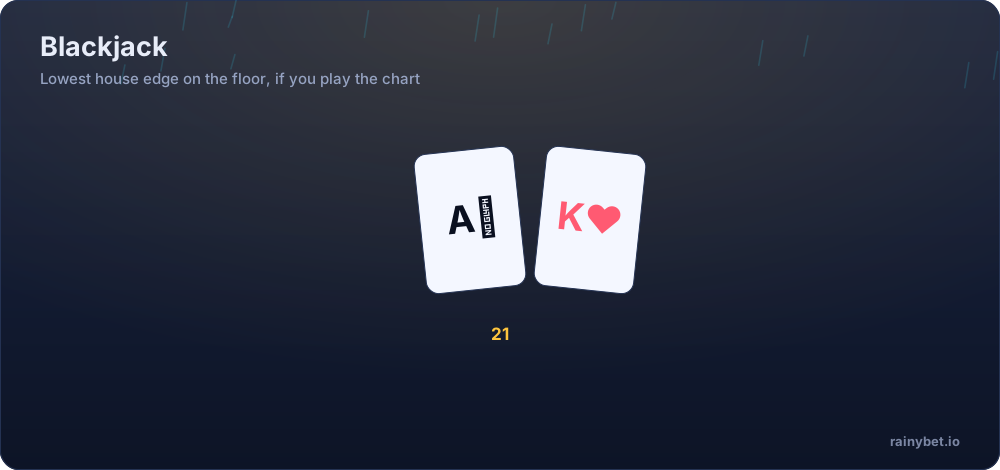
Every round deals from a freshly shuffled 6-deck shoe, so no round carries any memory of the last one. You get two cards and see one of the dealer's two; the dealer's hole card stays hidden until you stand, double or bust. A two-card total of 21 is a natural blackjack and pays 3 to 2 unless the dealer also has one, in which case the hand pushes.
From there you can hit to take another card, stand to keep your total, or double on your first two cards — doubling the bet, taking exactly one more card, and standing automatically afterward. Once you stand or bust, the dealer reveals the hole card and draws to a total of 17 or higher, standing on every 17 including a soft one (an Ace counted as 11).
This trainer does not offer splitting
Real basic strategy includes pair-splitting decisions — always splitting Aces and 8s, for example — that this simplified trainer does not model. The hit/stand/double hint below is accurate for the totals it covers, but a real table adds a fourth decision this page leaves out on purpose to keep the interface simple.
What the basic-strategy hint is doing
Basic strategy is a public, thoroughly studied table that names the statistically best action for every combination of your total and the dealer's upcard, assuming you cannot see any other card in the shoe. It splits into two halves: hard totals, where an Ace either isn't present or can only count as 1 without busting, and soft totals, where an Ace can count as 11 with room to spare.
| Your hard total | Dealer shows 2–6 | Dealer shows 7–A |
|---|---|---|
| 17 or more | Stand | Stand |
| 13–16 | Stand | Hit |
| 12 | Stand vs 4–6, hit vs 2–3 | Hit |
| 11 | Double | Double vs 7–10, hit vs Ace |
| 10 | Double | Double vs 7–9, hit vs 10/Ace |
| 9 | Double vs 3–6, hit vs 2 | Hit |
| 8 or less | Hit | Hit |
Soft totals follow the same logic with more room to manoeuvre, since an Ace cannot bust the hand on the next card. Soft 13–16 (Ace plus 2 through 5) generally doubles against a dealer 4, 5 or 6 and hits otherwise; soft 18 (Ace plus 7) stands against a dealer 2, 7 or 8, doubles against 3 through 6, and hits against 9, 10 or Ace; soft 19 and above simply stand.
Why correct play still doesn't erase the edge
Perfect basic strategy on a typical multi-deck, dealer-stands-on-soft-17 table brings the house edge down to roughly 0.5% — one of the lowest edges in the casino, but still a real, permanent disadvantage. Every correct hit, stand or double you make in this simulator is minimising that edge, not closing it; the 3-to-2 blackjack payout, the dealer's forced drawing rules and the shoe's card distribution together still favour the house by that fraction over enough hands.
Card counting is the one legitimate technique that can theoretically tip a depleting shoe toward the player at certain counts — and it depends entirely on tracking cards across many hands from a single shoe. This simulator reshuffles every round specifically so counting has nothing to attach to, which keeps the tool focused on teaching decisions rather than card-tracking skill.
How to use this without fooling yourself
Four ways to get something real out of a play-money table
- Play with the hint visible until your decisions match it almost every time.
Where people trip up: Basic strategy is a memorised table, not an intuition — seeing the correct answer next to your own instinct is the fastest way to close the gap between them.
- Then hide the hint and play a run of hands from memory.
Where people trip up: This is the only real test of whether the strategy has actually stuck, rather than just being recognised when shown.
- Pay close attention to every 12-versus-dealer-2-or-3 hand you're dealt.
Where people trip up: It is the single most commonly misplayed total in basic strategy — many players stand on instinct when the correct play is to hit.
- Notice how often doubling on 10 or 11 actually wins, over a run of hands.
Where people trip up: Doubling feels aggressive in the moment; seeing it pay off across a session is more convincing than being told it's correct in the abstract.
Blackjack simulator vs. real-money blackjack
| This simulator | Real-money blackjack | |
|---|---|---|
| Funds at risk | None — play money only | Real deposited funds |
| Ruleset | 6-deck shoe, dealer stands on all 17s, no splitting | Varies by table — check the game's info panel for exact rules and payouts before you sit down |
| Strategy guidance | Live public basic-strategy hint for hard and soft totals | No in-game hint; strategy is the player's responsibility |
| Purpose | Train hit/stand/double decisions with zero risk | Real wagering with real risk and real rakeback accrual |
The code to try it for real:
Honest pros and cons of practising here
What works about this offer
- Zero financial risk while you memorise a genuinely useful, publicly documented strategy
- Live hint compares your instinct against the correct play on every single turn
- Fresh shoe every round keeps the practice focused on decisions, not card tracking
- Fast enough to play dozens of hands in the time one real shoe usually allows
What to weigh up first
- Doesn't model splitting, a real basic-strategy decision left out to keep things simple
- Not tied to any specific operator's exact table rules, limits or payout structure
- A good session here proves the strategy, not that a real table will feel the same
- Cannot replicate the pacing or social dynamics of a real table with other players
Licence, geo-restrictions and playing safely
Licensing. Access is blocked in a number of countries and US states, and the list is maintained by the operator rather than published as a stable document. The current restricted list and licence details live on the operator’s own terms page — read them before you register.
Your side of it. Crypto casinos settle fast, which is exactly what makes them easy to overplay. Before your first deposit at Rainbet, set a deposit cap and a session timer in the account settings — not in your head.
- Deposit limits and self-exclusion tools live in account settings, not support chat
- A losing session is not a signal to raise the stake — it is a signal to stop
- Bonus turnover targets are not a reason to keep playing past your limit
- Free, confidential help: BeGambleAware and Gambling Therapy
Frequently asked questions
Does this blackjack simulator let me split pairs?
No. To keep the maths and the on-screen advice easy to follow, this simulator offers hit, stand and double only. Splitting is a real and important basic-strategy decision at a real table — our bankroll management guide covers bet-sizing principles that apply whichever ruleset you play under.
Why does the dealer stand on soft 17 here?
It is one of two common house rules — dealer stands on soft 17, or dealer hits soft 17 — and standing is the more player-friendly of the two, which is why it is the version this simulator teaches against. A real table's rule is printed on the felt; check it before you sit down, since the correct basic-strategy play can shift slightly under the other rule.
What is the basic-strategy hint actually based on?
A standard, publicly documented hard-totals and soft-totals basic-strategy chart for a multi-deck, dealer-stands-on-soft-17 game. It tells you the statistically best of hit, stand or double for your current total against the dealer's upcard — nothing here is an operator-specific number, it is public blackjack theory.
Does following basic strategy turn blackjack into a winning game?
No. Basic strategy minimises the house edge for a given ruleset; it does not remove it. Standard multi-deck blackjack under typical rules carries a house edge of roughly 0.5% when played with perfect basic strategy — a real, if small, disadvantage that no sequence of correct decisions eliminates.
Why does the shoe reshuffle every round instead of depleting like a real table?
Simplicity and honesty about what this tool is for. A real 6-deck shoe depletes as it's played, which is the basis of card counting — a skill this simulator does not attempt to teach or model. Reshuffling every round keeps every hand statistically independent and the basic-strategy hint always accurate for a fresh shoe.
Can I win real money by practising here?
No. The balance on this page is play money that exists only in your browser tab and resets the moment you reload. Nothing you do here connects to any real account or affects a real game anywhere.
Is blackjack provably fair when played for real?
At RNG-based blackjack tables, yes — many crypto casinos use a server-seed commit-reveal scheme you can verify after the round, the same general mechanic covered in our provably fair explainer. Live-dealer blackjack uses a filmed physical shoe instead, which is a different kind of fairness guarantee entirely.