

On this page (9 sections)
Play money only — read this first
This board runs on play money that lives only in your browser tab. Results here cannot be transferred to any real account, carry no predictive value for a real round, and no bomb count or cash-out rule turns a negative expected value into a positive one. It exists to show you the multiplier maths, not to forecast anything.
Play the simulator
This Mines simulator is a 25-tile grid-reveal tool: choose a bomb count, reveal tiles one at a time, watch a live combinatorial multiplier rise with each safe reveal, and cash out whenever you choose — all in play money, generated fresh in your browser.
Set a bomb count and click “New round” to begin.
The exact multiplier formula it uses
The board holds 25 tiles. If m is the bomb count and you have safely revealed k tiles so far, the fair multiplier this simulator computes for the current step is:
fair(k) = ∏i=0k−1 (25 − i) / (25 − m − i)
In words: for each safe reveal so far, multiply by the tiles remaining on that step divided by the safe tiles remaining on that step. The displayed multiplier is then fair(k) × (1 − edge), where edge is the house-edge input above, expressed as a fraction.
Worked example: 3 bombs, 2 safe reveals
First reveal: 22 safe tiles out of 25 remain, so the fair contribution is 25/22. Second reveal: 21 safe tiles out of 24 remain, contributing 24/21. Multiply them: (25/22) × (24/21) ≈ 1.299. At a 1% house-edge input, the displayed multiplier is 1.299 × 0.99 ≈ 1.29x — which is exactly what the simulator above will show you if you pick 3 bombs and reveal two safe tiles.
This is a fully worked-out combinatorial model, not a copy of any specific operator's live paytable. Real operators apply their own weighting on top of the same basic idea, and that exact table is not published as a fixed public figure.
What the house-edge input changes
Move the house-edge slider from 1% to 4% and every multiplier on the board drops by roughly three percentage points relative to the fair value — instantly, at every bomb count, at every reveal depth. That is the entire mechanism by which a house edge works: it is a flat discount layered on top of otherwise fair combinatorial odds, not something baked unevenly into any particular bomb count.
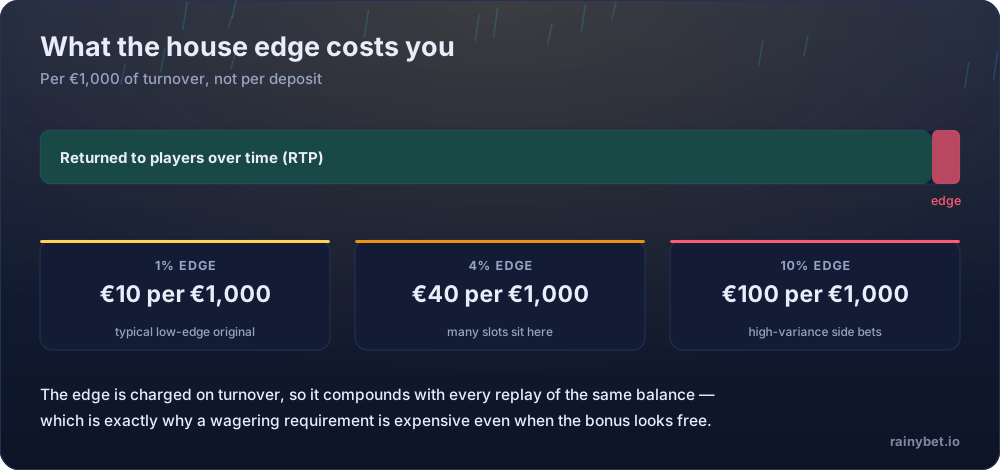
Try setting the edge input to 0%. The simulator then shows the pure fair odds with no house margin at all — useful for seeing exactly what the operator's cut is worth in isolation, before any edge is added back in.
Static payout table for common bomb counts
Computed with the same formula above at a fixed 1% demo edge, so you can check the simulator against known values without clicking a single tile. A dash means that many safe reveals is not possible at that bomb count — there simply aren't that many safe tiles left on the board.
| Bombs | After 1 reveal | After 3 reveals | After 5 reveals | After 10 reveals | After 15 reveals |
|---|---|---|---|---|---|
| 1 | 1.03x | 1.12x | 1.24x | 1.65x | 2.47x |
| 3 | 1.13x | 1.48x | 2.00x | 5.00x | 18.98x |
| 5 | 1.24x | 2.00x | 3.39x | 17.52x | 208.72x |
| 10 | 1.65x | 5.00x | 17.52x | 1,077.61x | — |
| 15 | 2.48x | 18.97x | 208.72x | — | — |
| 24 | 24.75x | — | — | — | — |
How to use this without fooling yourself
Four ways to get something real out of a play-money grid
- Pick a low bomb count first and watch how gently the multiplier climbs.
Where people trip up: Starting at a high bomb count makes the maths look more dramatic than it is useful — learn the curve at 1–3 bombs before judging higher counts.
- Deliberately keep revealing past where you'd normally cash out, at least once.
Where people trip up: Watching the bust happen on purpose, with nothing at stake, is the cheapest way to feel what 'one more reveal' actually costs before it costs anything real.
- Change the house-edge input and re-run the same bomb count.
Where people trip up: This is the fastest way to internalise that the edge is a flat scaling factor, not something that changes which bomb count is 'better'.
- Reset the session and try a genuinely high bomb count once, just to see the curve.
Where people trip up: High bomb counts bust almost immediately most of the time — seeing that first-hand is worth more than reading the word 'variance' in a paragraph.
Mines simulator vs. real-money Mines
| This simulator | Real-money Mines (e.g. Rainbet) | |
|---|---|---|
| Funds at risk | None — play money only | Real deposited funds |
| Multiplier source | General combinatorial formula shown in full above | Operator's own paytable — not published as a fixed figure |
| Fairness verification | Not applicable — no real wager exists to verify | Provably fair commit-reveal, checkable per round |
| Purpose | Teach the maths and the feel of variance | Real wagering with real risk and real rakeback accrual |
Once the maths above makes sense, our Rainbet Mines guide covers the real mechanic, provably fair verification and how bomb count interacts with rakeback accrual. The code itself:
Honest pros and cons of practising here
What works about this offer
- Zero financial risk while you learn exactly how the multiplier compounds
- The formula is shown in full — nothing about the maths is hidden
- House-edge input lets you isolate the operator's cut from the fair odds
- Fast enough to test a dozen bomb counts in the time one real round takes
What to weigh up first
- Not connected to any operator's real paytable or weighting table
- A play-money win here proves nothing about the outcome of a real round
- Cannot replicate the psychological pull of a real balance moving
- Provably fair verification does not apply, since there is no real wager to verify
Licence, geo-restrictions and playing safely
Licensing. Access is blocked in a number of countries and US states, and the list is maintained by the operator rather than published as a stable document. The current restricted list and licence details live on the operator’s own terms page — read them before you register.
Your side of it. Crypto casinos settle fast, which is exactly what makes them easy to overplay. Before your first deposit at Rainbet, set a deposit cap and a session timer in the account settings — not in your head.
- Deposit limits and self-exclusion tools live in account settings, not support chat
- A losing session is not a signal to raise the stake — it is a signal to stop
- Bonus turnover targets are not a reason to keep playing past your limit
- Free, confidential help: BeGambleAware and Gambling Therapy
Frequently asked questions
How is the Mines multiplier actually calculated here?
As a running product. Before each reveal, the fair multiplier for that step is the number of tiles left on the board divided by the number of safe tiles left. Multiply that ratio together for every safe reveal so far and you get the fair multiplier for the round, which this simulator then discounts by the house-edge percentage you set.
Why does the multiplier grow faster with more bombs?
More bombs means fewer safe tiles remain at every stage, so each individual reveal is riskier and the fair odds for that reveal are worse. A worse per-reveal probability produces a larger multiplier contribution, which is why a 15-bomb board climbs far faster than a 1-bomb board.
Does this simulator use Rainbet's exact multiplier table?
No. This is a general combinatorial model for a 5×5 grid, built from first principles and shown in full on this page. Rainbet and other operators may apply their own weighting on top of the base maths, and that exact table is not published as a fixed figure. Play the real thing at Rainbet Mines once you understand the shape of the curve.
What does the house-edge input actually change?
It scales every fair multiplier down by a fixed percentage before displaying it, exactly the way a real operator's edge sits on top of the fair combinatorial odds. Raise it and every payout in the simulator shrinks proportionally; the shape of the curve stays identical.
Is there a way to pick a bomb count that beats the house edge?
No. Every bomb count applies the same discount factor to a mathematically fair curve, so every bomb count carries the identical house edge you set in the input. Bomb count changes variance — how steep the climb is and how often you bust — not the expected value.
Can I lose real money on this page?
No. The balance shown is play money that exists only in your browser tab and resets the moment you reload the page. Nothing here connects to a real account anywhere.
Is Mines provably fair when played for real?
At operators like Rainbet, yes — the bomb layout is committed to (hashed) before you play and revealed afterward so you can verify it wasn't changed. See our Rainbet provably fair guide for the verification steps; this simulator's board is generated fresh in your browser and has no seed to verify because there is no real wager attached to it.