

On this page (10 sections)
How Rainbet Mines works
Mines is a grid-reveal casino original: a player chooses a grid size and a number of hidden bombs, then reveals tiles one at a time. Each safe reveal raises a multiplier applied to the stake; revealing a bomb ends the round and forfeits it.
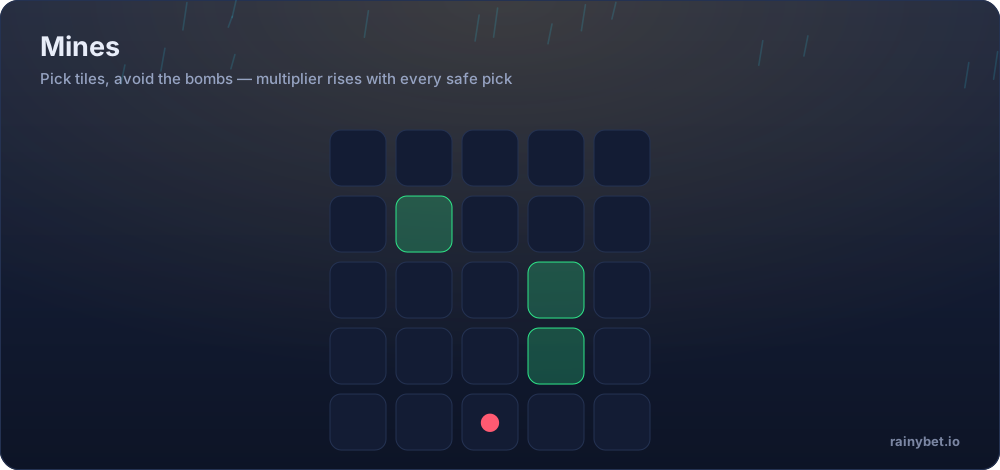
There is no card-counting equivalent and no hidden skill layer. The entire game is a sequence of the same choice: take the next reveal, or stop. That makes it a genuinely easy first game to learn, which is why it's usually the first Original we point new players toward.
The multiplier maths behind Mines
The general shape of the maths is straightforward, even without a published weighting table for Rainbet specifically. On any grid-reveal game, the fair odds of a given reveal being safe are roughly the count of remaining safe tiles divided by the count of remaining unrevealed tiles. As bombs are set, safe tiles shrink faster relative to the total, so later reveals in a round carry higher risk than earlier ones.
A simplified illustration, not a Rainbet-specific figure
On a 25-tile grid with 3 bombs, the first reveal has 22 safe tiles out of 25 — good odds. By the fifteenth safe reveal, only 7 safe tiles remain out of 10 unrevealed — meaningfully worse odds on the same round. The exact payout curve and house-edge adjustment Rainbet applies are not published as a fixed table. This example illustrates the general mechanic, not Rainbet's specific numbers.
Rather than doing this arithmetic in your head mid-session, our Mines simulator shows the multiplier curve directly and lets you test different bomb counts with no funds at risk.
How to play Mines step by step
Four steps, repeated every round
- Set your stake and choose a bomb count before starting the round.
Where people trip up: Lower bomb counts are the easier starting point while you're learning how the multiplier curve behaves.
- Reveal a tile. If it's safe, the multiplier rises and you choose again.
Where people trip up: There is no way to see ahead — each reveal is an independent decision based only on tiles remaining.
- Cash out at any point to lock in the current multiplier.
Where people trip up: Waiting for 'one more reveal' after you'd planned to stop is the single most common way players give back a good run.
- If you reveal a bomb, the round ends and the stake for that round is lost.
Where people trip up: This is not a bug or bad luck specifically — it is the mechanic working as designed at whatever bomb count you chose.
Bomb count and risk: choosing your setup
| Bomb count | Typical feel | Best suited to |
|---|---|---|
| Low (1-3 on a large grid) | Gentle multiplier growth, lower bust risk per reveal | Beginners learning the mechanic |
| Medium | Faster multiplier growth, meaningfully higher bust risk | Players comfortable with the curve already |
| High | Steep multiplier growth, high bust risk per reveal | Deliberate high-variance play only |
This is the same general risk-reward trade every Rainbet Original shares in some form — see our Rainbet games overview for how Mines compares against Plinko and Blackjack on edge and volatility.
Common Mines mistakes beginners make
- Choosing a high bomb count before understanding how the curve behaves at a low one
- Chasing 'one more reveal' after already deciding to cash out
- Treating a winning streak as evidence the next reveal is safer — each reveal is independent
- Not setting a stop-loss for the session before starting, then improvising one after losses
- Skipping the simulator entirely and learning the mechanic with real funds instead
Is Mines provably fair?
Provably fair verification commits a game's outcome (here, the bomb layout) to a hash before betting begins, then reveals the underlying seed afterward so the player can re-hash it and confirm nothing was changed after the fact.
Mines is verified using the same commit-reveal system as Rainbet's other Originals: the bomb layout is committed to (hashed) before you start playing, and the underlying seed can be revealed and re-hashed afterward to confirm it matches the original commitment. That confirms the layout wasn't altered after your bets were placed. Full walkthrough on our Rainbet provably fair guide and the general provably fair explainer.
Mines vs Plinko: which to start with
| Mines | Plinko | |
|---|---|---|
| Number of decisions per round | Many (one per reveal) | One (before the drop) |
| Player control over risk | High — bomb count and stop point | Moderate — risk setting only |
| Easiest to learn | Slightly steeper learning curve | Slightly simpler to grasp instantly |
See our Rainbet Plinko guide for the full breakdown of that mechanic and its own risk-row trade-offs.
Honest pros and cons
What works about Rainbet
- Simple, learnable mechanic with no hidden skill layer
- Full player control over stop point, unlike a fixed-outcome round
- Provably fair and independently verifiable per round
- A free simulator exists to learn the curve before risking funds
What to weigh up first
- Exact multiplier and weighting figures are not published for Rainbet specifically
- Low house edge means slower rakeback accrual compared with higher-edge games
- 'One more reveal' is a genuinely easy trap to fall into mid-streak
Licence, geo-restrictions and playing safely
Licensing. Access is blocked in a number of countries and US states, and the list is maintained by the operator rather than published as a stable document. The current restricted list and licence details live on the operator’s own terms page — read them before you register.
Your side of it. Crypto casinos settle fast, which is exactly what makes them easy to overplay. Before your first deposit at Rainbet, set a deposit cap and a session timer in the account settings — not in your head.
- Deposit limits and self-exclusion tools live in account settings, not support chat
- A losing session is not a signal to raise the stake — it is a signal to stop
- Bonus turnover targets are not a reason to keep playing past your limit
- Free, confidential help: BeGambleAware and Gambling Therapy
Frequently asked questions
How does Rainbet Mines work?
You pick a grid size and how many hidden bombs it contains, then reveal tiles one at a time. Each safe tile increases a multiplier; hitting a bomb ends the round and forfeits the stake. You can cash out after any safe reveal instead of continuing.
What is the Mines multiplier formula?
Conceptually, the fair multiplier for each reveal is close to the total tiles remaining divided by the safe tiles remaining, adjusted for the house edge. More bombs on the grid means fewer safe tiles per reveal, so each successful reveal is worth more but the chance of hitting a bomb rises with every step.
Is Rainbet Mines provably fair?
Mines is one of the Originals that uses commit-reveal provably fair verification: the bomb layout is committed to (hashed) before you play and can be checked against the revealed seed afterward. Our Rainbet provably fair guide covers the verification steps.
How many bombs should a beginner choose in Mines?
A lower bomb count produces a lower house edge per reveal and a gentler multiplier curve, which is easier to reason about while you're learning the mechanic. Higher bomb counts produce faster-growing multipliers and a much steeper chance of an early loss.
Can I practise Mines without risking money?
Yes. Our Mines simulator lets you run the exact mechanic with no funds at stake, which is the fastest way to understand the multiplier curve before playing for real.
Does Mines earn Rainbet rakeback the same as other games?
Rakeback accrues on the house margin generated by turnover, and Mines' edge sits at the lower end of the Originals suite. It earns rakeback more slowly than a higher-edge slot for the same stake size, and costs less at the same time.