

On this page (9 sections)
Play money only — no simulator beats a negative edge
This table runs on play money that lives only in your browser tab. Nothing here predicts a real hand, nothing carries over to a real account, and no betting pattern, streak-tracking method or commission workaround turns Banker, Player or Tie into a positive-expectation bet. Every hand reshuffles a fresh shoe and draws independently of the last.
Play the simulator
This baccarat simulator deals Player and Banker hands from a fresh multi-deck shoe every round, applies the standard third-card draw rules and a 5% commission on Banker wins, and settles Banker, Player or Tie bets entirely in play money.
Pick a bet and deal a hand.
The third-card draw rules in full
Baccarat hand values run 0 to 9: tens and face cards count as zero, an Ace counts as one, everything else counts at face value, and any total above 9 drops its tens digit — a hand of 7 and 8 is worth 5, not 15. Two-card totals of 8 or 9 are “naturals” and end the hand immediately with no further cards drawn for either side.
When neither side has a natural, the Player acts first: draw a third card on a total of 0 through 5, stand on 6 or 7. The Banker's decision is more layered — if the Player stood, Banker draws on 0–5 and stands on 6–7. If the Player drew a third card, Banker's action depends on both its own total and the value of that Player third card:
| Banker total | Draws a third card when Player's third card is |
|---|---|
| 0, 1 or 2 | Always draws |
| 3 | Any value except 8 |
| 4 | 2, 3, 4, 5, 6 or 7 |
| 5 | 4, 5, 6 or 7 |
| 6 | 6 or 7 |
| 7 | Never draws — always stands |
Why Banker pays less than it wins
Because the Banker draws with information the Player doesn't have — Banker's third-card decision reacts to the Player's third card, while the Player draws blind — Banker wins more hands over time: roughly 45.86% against Player's 44.62%, with the remaining roughly 9.52% landing as a Tie. Left uncorrected, that gap would make Banker a clearly better bet than Player, which is why almost every table charges a 5% commission on Banker wins to bring the two bets close together.
Worked example: a 100-unit Banker win
Bet 100 units on Banker and win. The commission is 5% of the win, so you receive 100 × 0.95 = 95 units of profit plus your original 100 back — a net gain of 95, not 100. That single deduction is what brings Banker's house edge down to roughly 1.06%, close to Player's roughly 1.24%, from what would otherwise be a much larger gap in Banker's favour.
Tie sits in a different category entirely. At a common 8-to-1 payout against a roughly 9.52% chance, the house edge on Tie runs in the region of 14% — several times worse than either Banker or Player, despite the appealing payout size.
Batch mode: 500 hands against the true frequencies
A handful of manual hands says almost nothing about whether Banker really does win more often than Player — you're watching noise at that sample size. Click “Run 500 hands” and the simulator deals 500 rounds instantly using the exact rules above, then reports the observed percentage of Banker wins, Player wins and Ties next to their theoretical figures of roughly 45.86%, 44.62% and 9.52%.
Run the batch a few times in a row
Each run of 500 hands will land close to, but not exactly on, the theoretical percentages — sometimes Banker runs a little hot, sometimes Tie shows up more than its share. That variation shrinks the more hands you run; it never resolves into a pattern you can bet on ahead of time.
How to use this without fooling yourself
Four ways to get something real out of a play-money table
- Deal ten hands manually while betting Banker every time, and note how it feels.
Where people trip up: A 45.86% bet still loses more than half the time it's dealt — feeling that directly is worth more than reading the percentage on a page.
- Switch to Player for another ten and compare how close the outcomes feel.
Where people trip up: The two bets are close enough after commission that ten hands rarely shows a meaningful difference — that's the point, not a flaw in either bet.
- Bet Tie for a short manual run purely to feel how rarely it lands.
Where people trip up: A payout of 8 to 1 sounds generous until you watch it not show up for a long stretch of hands, which happens roughly nine times out of ten.
- Run the 500-hand batch on Banker and Player back to back and compare final bankrolls.
Where people trip up: Both should land in a broadly similar, slightly negative range — the visible proof that the 5% commission is doing its job.
Baccarat simulator vs. real-money baccarat
| This simulator | Real-money baccarat | |
|---|---|---|
| Funds at risk | None — play money only | Real deposited funds |
| Draw rules | Standard third-card table, shown in full above | Same public rules at almost every table |
| Commission | 5% on Banker wins, applied exactly as described | Typically 5%, though side bets and Tie payouts vary — check the operator's own game rules |
| Purpose | Teach the draw rules and true outcome frequencies | Real wagering with real risk and real rakeback or cashback accrual |
The code to try it for real:
Honest pros and cons of practising here
What works about this offer
- Zero financial risk while you learn the exact third-card draw rules in full
- 5% Banker commission is applied precisely as it works at a real table
- Batch mode compresses 500 hands into seconds, which real play never allows
- Clear, fast demonstration of why Tie's payout doesn't make it a good bet
What to weigh up first
- Doesn't model side bets like Player Pair or Banker Pair, which some operators offer
- A hot batch run here proves the theoretical frequencies, not that a real session will match
- Cannot replicate the pacing of a real live-dealer shoe or a filled table
- Provably fair verification does not apply the way it does for RNG-based Originals
Licence, geo-restrictions and playing safely
Licensing. Access is blocked in a number of countries and US states, and the list is maintained by the operator rather than published as a stable document. The current restricted list and licence details live on the operator’s own terms page — read them before you register.
Your side of it. Crypto casinos settle fast, which is exactly what makes them easy to overplay. Before your first deposit at Roobet, set a deposit cap and a session timer in the account settings — not in your head.
- Deposit limits and self-exclusion tools live in account settings, not support chat
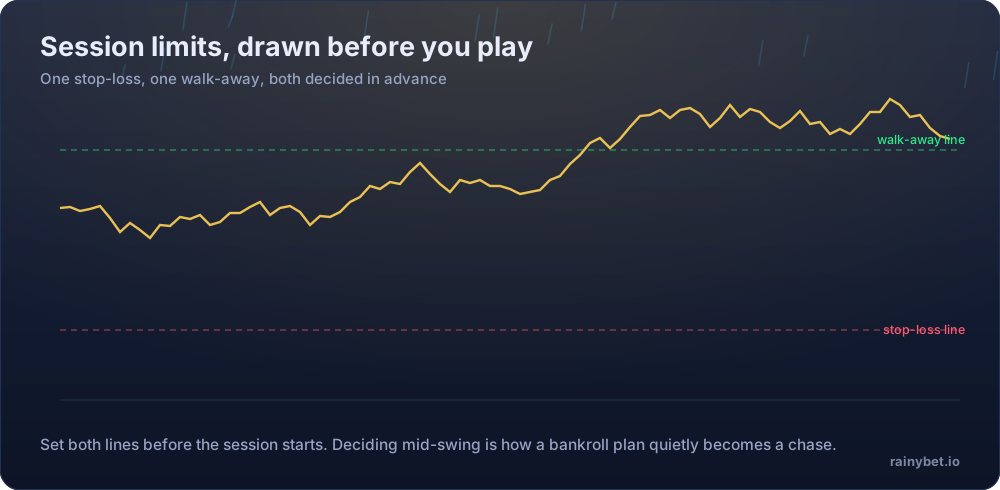
- A losing session is not a signal to raise the stake — it is a signal to stop
- Bonus turnover targets are not a reason to keep playing past your limit
- Free, confidential help: BeGambleAware and Gambling Therapy
Frequently asked questions
Why does the Banker bet pay less than the Player bet?
Because the Banker position wins slightly more often — roughly 45.86% of hands against Player's 44.62% — thanks to a small edge built into the third-card draw rules. To keep both bets close to fair, most tables charge a 5% commission on Banker wins, which this simulator applies exactly as described.
What are the actual third-card rules this simulator uses?
Standard baccarat rules: the Player draws a third card on an initial total of 0–5 and stands on 6 or 7. If the Player stands, the Banker draws on 0–5 and stands on 6–7. If the Player draws a third card, the Banker's decision depends on both the Banker's total and the Player's third card, following the standard baccarat drawing table shown on this page in full.
What does the 500-hand batch mode actually prove?
It plays 500 hands instantly using the exact rules above and reports the observed frequency of Banker, Player and Tie outcomes next to the theoretical figures: about 45.86%, 44.62% and 9.52%. Run it a few times and the observed numbers land close to, but rarely exactly on, the theoretical ones — ordinary sampling variance around a fixed set of probabilities.
Is the Tie bet a good idea if it pays more?
No — a bigger payout on a rarer outcome does not automatically mean a better bet. A typical 8-to-1 Tie payout against a roughly 9.52% win chance works out to a house edge in the region of 14%, far worse than Banker's roughly 1.06% or Player's roughly 1.24% under the same commission structure. The batch mode makes the rarity of Tie obvious very quickly.
Does the number of decks in the shoe change these odds much?
Only slightly. Baccarat's outcome frequencies are close to identical whether the shoe holds one deck or eight, because the third-card rules — not deck count — drive almost all of the small edge between Banker and Player. This simulator reshuffles a fresh multi-deck shoe every hand so no session can deplete it.
Can betting patterns or tracking previous outcomes beat this simulator?
No. Every hand reshuffles the shoe and draws independently of every previous hand, so there is no streak, pattern or 'due' outcome to exploit — a run of five Banker wins in a row carries exactly the same probabilities on the next hand as the very first hand of a session.
Is this the same commission and payout structure a real casino uses?
The 5% Banker commission and standard even-money Player payout are the industry-standard structure and public, verifiable maths. Individual operators may vary Tie payouts or offer side bets not modelled here, and those specifics are best checked on the operator's own game rules page.