
On this page (8 sections)
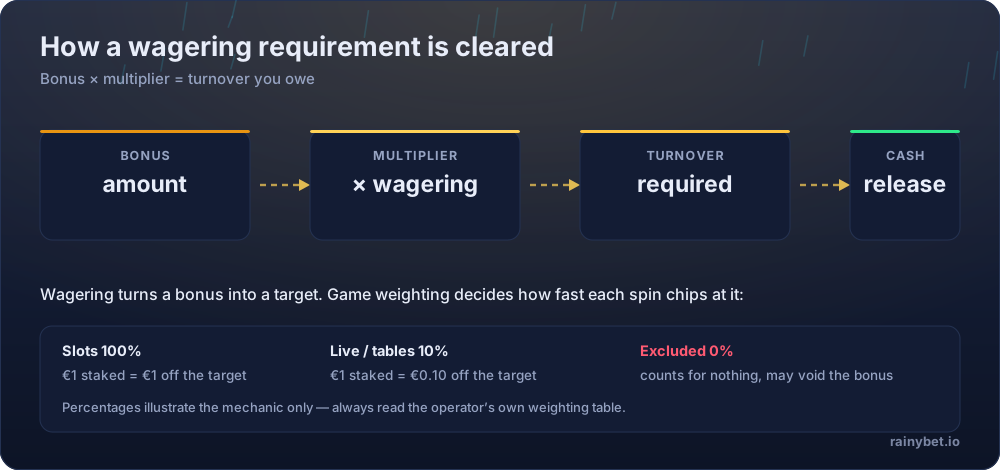
A wagering requirement (also called a rollover or turnover requirement) is a multiplier applied to a bonus, a deposit, or both, that sets the total value of bets you must place before bonus funds convert to withdrawable balance.
What a wagering requirement actually asks of you
Three numbers turn a headline bonus into a real obligation: the multiplier, what it is multiplied against, and how much of each stake counts. Get any one of them wrong in your head and the bonus looks better or worse than it is. This tool does not guess at any of them — you supply your own account's terms, and the arithmetic is exact.
It also prices the part most bonus pages skip: the expected cost of actually placing that turnover, given the house edge of the game you clear it on. That cost is what decides whether a bonus is worth taking at all.
The wagering requirement calculator
Figures use the same currency you enter — the units cancel out, so dollars, euros or a stablecoin all work.
What each number in the tool means
Total turnover required is the multiplier times the amount it applies to — the bonus, the deposit, or both. It is the number operators quote, and by itself it tells you nothing about cost.
Weighted turnover is the actual money you must stake once game weighting is factored in: total turnover required, divided by the weighting percentage. At 100% weighting the two numbers match. Below that, weighted turnover is always the larger, real figure.
Expected cost of clearing is weighted turnover multiplied by the house edge, as a decimal. It is the amount you are mathematically expected to lose while placing that turnover — not a worst case, an average.
Expected value of the bonus is the bonus amount minus that expected cost. Positive means the bonus is worth more, on average, than clearing it costs. Negative means the opposite, and the tool says so in plain words.
The formula behind every number
Turnover required = multiplier × base amount. Weighted turnover = turnover required ÷ (weighting ÷ 100). Expected cost = weighted turnover × (house edge ÷ 100). Expected value = bonus − expected cost. Four steps, no hidden constants.
Why game weighting can multiply your workload
Weighting exists because different games return the operator different margins per unit staked. A slot might count 100% of every stake toward a requirement. A blackjack table, with a much lower house edge, might count only 10% or 20%, because the operator's expected margin from that stake is far smaller.
The effect on you is direct: at 10% weighting you must physically stake ten times more money than the raw turnover figure to satisfy the same requirement. Combined with a low house edge that can still work out cheaply — combined with a high house edge, it is close to the worst version of this trade. Our house edge guide breaks down why edge and weighting have to be read together, never separately.
Worked example: a typical deposit bonus
Take a $100 bonus on a $50 deposit, a 30× multiplier applied to bonus plus deposit, 100% weighting, and a 4% house edge. Total turnover required is 30 × $150 = $4,500. At 100% weighting, weighted turnover is the same $4,500. Expected cost is $4,500 × 4% = $180. Expected value is $100 − $180 = −$80 — a bonus that costs more to clear, on average, than it pays.
Drop the weighting to 10% with everything else unchanged and weighted turnover jumps to $45,000. Expected cost at the same 4% edge becomes $1,800, and the expected value falls to −$1,700. The multiplier did not change. The weighting did all of that damage on its own.
Try it yourself
Put those numbers into the tool above and change one field at a time. Watch which single input moves the verdict the most — on most real offers, it is weighting, not the headline multiplier.
When is clearing a wagering requirement worth it?
The honest rule: if the expected value line is positive, the bonus is, on average, worth more than the cost of clearing it at the game and edge you entered. If it is negative, you are expected to pay more in losses than the bonus is worth — even though variance means many individual sessions will still finish ahead.
Low house edge and high weighting are the two conditions that make a wagering requirement worth clearing. A rakeback offer sidesteps the question entirely, because it is usually paid without a requirement to clear at all — see our Rainbet VIP calculator and the other brand rakeback tools for that comparison.
Traps that quietly inflate the real cost
- Multiplier applied to bonus + deposit. This roughly doubles the base amount compared with bonus-only, which roughly doubles every downstream number.
- Low weighting on the games you actually enjoy. If your preferred game weights at 10–20%, check the maths before assuming the offer suits your usual play.
- Max bet rules while a bonus is active. Even a positive expected value on paper can be voided by a single stake over the account's max-bet limit — check the live limit in your bonus terms before sizing a bet.
- Time limits on the requirement. A generous multiplier is worth less if the window to clear it is short — the exact validity period is set per offer, so check the expiry date in your account before relying on it.
- Assuming 'wagering requirement' and 'rollover' always mean the same maths. Some operators define these terms slightly differently — read the definition on your own account page, not just the label.
Licence, geo-restrictions and playing safely
Licensing. Wagering requirements exist across almost every regulated and unregulated operator. Treat a negative expected value result as a reason to walk away, not a puzzle to solve by staking more.
Your side of it. Crypto casinos settle fast, which is exactly what makes them easy to overplay. Before your first deposit at these operators, set a deposit cap and a session timer in the account settings — not in your head.
- Deposit limits and self-exclusion tools live in account settings, not support chat
- A losing session is not a signal to raise the stake — it is a signal to stop
- Bonus turnover targets are not a reason to keep playing past your limit
- Free, confidential help: BeGambleAware and Gambling Therapy
Frequently asked questions
What is a wagering requirement, in one sentence?
It is a multiplier applied to a bonus, a deposit, or both, that tells you how much total turnover you must generate in real bets before the bonus money becomes withdrawable.
Does the wagering requirement calculator work for any casino?
Yes. It is pure arithmetic — bonus amount, deposit, multiplier, weighting and house edge — and none of those numbers are specific to one operator. Enter the terms shown on your own account screen and the maths is exact.
Why does game weighting matter so much?
Weighting sets what fraction of a stake counts toward the requirement. At 100% weighting every unit staked counts in full. At 10% weighting you must stake ten times as much money to generate the same counted turnover, which multiplies your expected cost by the same factor.
What does a negative expected value actually mean here?
It means the expected loss from wagering through the requirement, at your house edge, is larger than the bonus itself. On average, across many players in that situation, clearing the bonus costs more than it pays — even though some individual players will still finish ahead.
Should the multiplier apply to the deposit as well as the bonus?
Check your account terms rather than assume. Some offers apply the multiplier to the bonus only, some to the deposit only, and some to bonus plus deposit combined — the last of those produces by far the largest turnover requirement, so it changes the verdict completely.
Can I use this to compare two different bonus offers?
Yes — run each offer's numbers through separately and compare the expected value line. A bigger headline bonus with a higher multiplier or lower weighting can easily have a worse expected value than a smaller, cleaner offer.
Does clearing a wagering requirement guarantee I keep the bonus?
No. Most operators can still void a bonus for pattern play, low-risk betting or breaching a max-bet rule while the requirement is active. The calculator prices the maths of clearing it; it cannot price an operator's discretion clause.
Where do I find my own wagering multiplier and weighting figures?
In your account's promotions or bonus terms panel, not in marketing copy. Operators rarely publish a single fixed multiplier for every offer, which is why this tool asks for your own numbers instead of guessing one for you.