
On this page (9 sections)
Bankroll management is the practice of setting how much money you can afford to lose, how large a single bet should be relative to that amount, and when you stop, all decided before a session begins rather than adjusted during it.
This is not a page about winning more. There is no bankroll rule that changes house edge, and nothing here is framed as a strategy to beat a game. It is a page about protecting money you have already decided you can afford to risk, from the specific failure mode that costs people the most: decisions made in the middle of a losing session, by a version of themselves with worse judgement than the one who sat down.
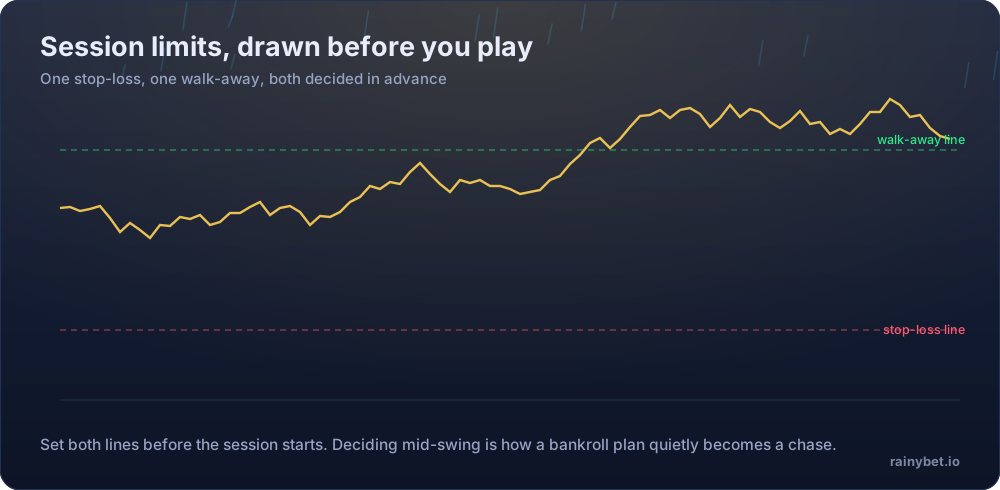
The one rule: decide before you play, not during
Every limit in this guide shares one property: it has to be set before you open the cashier, not adjusted once you're a few bets into a losing run. That is not a moral instruction — it's a recognition of how judgement actually degrades under a losing streak. The person deciding "just one more deposit" mid-session is working with worse information and worse impulse control than the person who set a limit an hour earlier with a clear head.
Why this has to happen first, not during
A losing streak changes how a bet feels, not just your balance. The same $50 bet that felt significant at the start of a session can feel routine an hour into a downswing. Pre-set limits exist specifically to override that shift in feeling with a decision made before it happened.
Session limits: the amount you can afford to lose today
A session limit is the total amount you are prepared to lose in one sitting, set as a fixed number before you deposit. It is not your entire bankroll and it is not an aspiration — it is the specific number that, if reached, ends the session regardless of how the last few bets went.
- Pick a number you could lose today without it affecting bills, savings or anything else due this week
- Write it down or set it as a deposit limit in account settings — not as a number you're trusting yourself to remember
- Treat reaching it as the session ending, not as a signal to deposit again to "finish properly"
- Set it lower than you think you need to the first few times you try this — you can always raise it later once you trust your own follow-through
A session limit answers one question only: how much can this specific sitting cost. It says nothing about bet size within the session, which is a separate decision covered next.
Unit sizing: why bet size relative to bankroll matters
Unit size is the amount wagered on a single bet, typically expressed as a small, fixed fraction of the session bankroll rather than a flat dollar figure decided on the spot.
The same $20 bet is a very different decision against a $200 session bankroll than against a $2,000 one. Framing bet size as a percentage of bankroll, rather than a flat amount, is what lets the same rule scale sensibly whether the session is small or large.
| Session bankroll (hypothetical) | Small unit size (1%) | Larger unit size (5%) | What changes |
|---|---|---|---|
| $200 | $2 per bet | $10 per bet | At 5%, roughly 20 losing bets in a row empties the bankroll; at 1%, it takes about 100 |
| $1,000 | $10 per bet | $50 per bet | The dollar amounts scale, but the same 20-bet or 100-bet losing-streak math still applies |
Smaller unit sizes don't change the house edge and don't make a game more winnable. What they change is how many consecutive losses — which will happen sometimes, purely from variance — it takes to reach zero. A smaller unit size buys more rounds of ordinary bad luck before that happens.
Risk of ruin, explained without the jargon
Risk of ruin is the probability that a losing streak — entirely within normal statistical variance, not the result of bad luck outside the odds — brings a bankroll to zero before the player decides to stop.
This probability is not fixed. It rises as unit size grows relative to bankroll, and it rises as house edge increases, because a larger edge makes losing streaks both more frequent and harder to recover from within the same session. Two people with identical bankrolls and identical edges but different unit sizes carry meaningfully different risk of ruin — which is the entire argument for keeping units small, restated in one sentence.
Our house edge guide works through why edge is charged on turnover rather than deposit size; risk of ruin is what happens when that turnover accumulates faster than a bankroll can absorb the variance around it.
Stop-loss and walk-away lines, set in advance
A four-step way to make walking away a decision you already made
- Before depositing, write down two numbers: the amount you'll stop at if you're losing, and the amount you'll stop at if you're winning.
Where people trip up: Most people only set the first number. A win line matters just as much — without one, winnings often get wagered straight back into more turnover.
- Set the losing number as an actual deposit or loss limit in account settings, not a mental note.
Where people trip up: A mental stop-loss is the first thing a losing streak erodes. An account-level limit keeps applying even after judgement has already shifted.
- Set a session length timer alongside the money limit — time distorts as fast as money does in a long session.
Where people trip up: Long sessions increase turnover even at a fixed unit size, simply because more rounds get played. A time limit caps that independently of the money limit.
- When either line is reached, stop — regardless of how the last few bets went.
Where people trip up: "I'll stop after this next win" and "I'll stop after I get back to even" are both the chasing pattern described in the next section, wearing a stop-loss costume.
Why chasing losses is a maths problem before it is a willpower problem
Chasing losses usually gets framed as a self-control failure. It's worth being precise about why it's also, independently, a bad bet mathematically. Increasing bet size after a loss to "win back" the deficit does two things at once: it raises the amount at risk on the very next bet, and it does so on a game whose edge has not changed and is not owed to you as a comeback. The house edge does not track your session P&L and does not adjust in your favour because you're behind.
The exact moment chasing turns into ruin risk
Raising the unit size after a loss is functionally the same decision as raising unit size from the start — except it's made with the least clear judgement of the whole session. That's the maths problem underneath the willpower problem: the bet is objectively worse, on top of being harder to resist.
None of this means a losing streak is a signal something is wrong with a game. Variance produces long losing streaks on perfectly ordinary house edges all the time — that's what randomness looks like. The response that protects a bankroll is the pre-set stop-loss from the previous section, not a bigger bet.
Crypto's speed is a real risk factor, not a convenience footnote
Crypto deposits are usually genuinely fast — often confirming within minutes, with no card issuer able to decline or delay a gambling transaction. That speed is a real convenience, and it is also a real risk factor that deserves to be named plainly rather than treated as a footnote.
A card deposit sometimes gets declined, or takes long enough to process that a losing session has time to cool before more money arrives. A crypto top-up removes that friction almost entirely. The pause that used to interrupt a bad session — waiting on a bank, waiting on a card authorisation — simply is not there in the same way. Our guide to buying crypto for gambling covers the mechanics of that speed from the funding side; here, the point is that the speed itself is a reason to set firmer limits, not looser ones.
Practically: if your deposit limit lives only in your head, crypto settlement is fast enough to get past it before the thought "maybe I should stop" fully forms. If it lives in account settings as an actual cap, the speed of the network on the way in doesn't matter — the limit still holds.
Where these limits actually live
Every limit described above works best when it exists somewhere other than your own memory. Deposit caps, session-length timers, loss limits and self-exclusion tools typically live in account settings across the operators we cover, not in support chat and not as a promise you make to yourself.
- Deposit limits — a hard cap on how much can be added in a day, week or month
- Session or reality-check timers — a prompt or forced pause after a set amount of time playing
- Self-exclusion — a full, timed lock-out of the account, usually the strongest tool available
- Our responsible gambling guide covers where these tools live in more detail, plus where to get free, confidential help if gambling has stopped feeling like a choice
None of this requires giving anything up. It requires deciding the shape of a session before it starts, the same way a bankroll for anything else — a monthly grocery budget, a trip's spending money — gets decided in advance rather than mid-spend. Compare that discipline against what the edge actually costs in our house edge guide, and run your own numbers in the wagering calculator before your next deposit.
Licence, geo-restrictions and playing safely
Licensing. Access is blocked in a number of countries and US states, and the list is maintained by the operator rather than published as a stable document. The current restricted list and licence details live on the operator’s own terms page — read them before you register.
Your side of it. Crypto casinos settle fast, which is exactly what makes them easy to overplay. Before your first deposit at these operators, set a deposit cap and a session timer in the account settings — not in your head.
- Deposit limits and self-exclusion tools live in account settings, not support chat
- A losing session is not a signal to raise the stake — it is a signal to stop
- Bonus turnover targets are not a reason to keep playing past your limit
- Free, confidential help: BeGambleAware and Gambling Therapy
Frequently asked questions
What is bankroll management in gambling?
Bankroll management is the set of limits you decide before you play — how much you can afford to lose, how big a single bet should be relative to that amount, and at what point you stop — so that decisions get made in advance, not in the middle of a session when judgement is least reliable.
How much of my bankroll should I bet per round?
There is no single correct percentage, but many recreational bankroll frameworks use a small unit size, often in the region of 1–2% of a session bankroll per bet, precisely so a losing streak of ordinary length does not wipe out the whole session. The exact figure is a personal risk decision, not a fact we can hand you.
What is risk of ruin?
Risk of ruin is the probability that a losing streak, entirely within normal statistical variance, reduces your bankroll to zero before you choose to stop. It rises sharply as bet size grows relative to bankroll and as house edge increases — which is why unit sizing and edge both matter to the same outcome.
Why is chasing losses a maths problem, not just a willpower problem?
Because increasing bet size after a loss to "get back to even" increases both the amount at risk and the speed at which a bankroll can hit zero, on top of the house edge working against every individual bet. The urge to chase is psychological, but the damage it causes is arithmetic and measurable before a single extra bet is placed.
Why does crypto's fast settlement make overplaying easier?
Because there is no processing delay between deciding to deposit more and the funds actually landing. A card deposit sometimes takes minutes to clear or gets declined outright; a crypto top-up can confirm in the time it takes to switch tabs, which removes a natural pause that used to interrupt a losing session.
Should I set my limits inside my head or somewhere else?
Somewhere else, always. A limit that only exists as an intention is the first thing a bad session erodes. Deposit caps, session timers and self-exclusion tools set in account settings continue to apply even after your judgement has already been affected by a losing run.
Is a stop-loss the same as a strategy to win more?
No, and that distinction matters. A stop-loss protects the bankroll you already have; it does not improve your odds on any individual bet. Nothing in bankroll management changes the house edge — it only decides how much exposure to that edge you accept before you walk away.