
On this page (9 sections)
Buying crypto for gambling typically means purchasing coins on an exchange with local currency, moving them through a wallet, and sending them on to a casino's deposit address on the correct blockchain network — three separate steps, each with its own fee and its own way to go wrong.
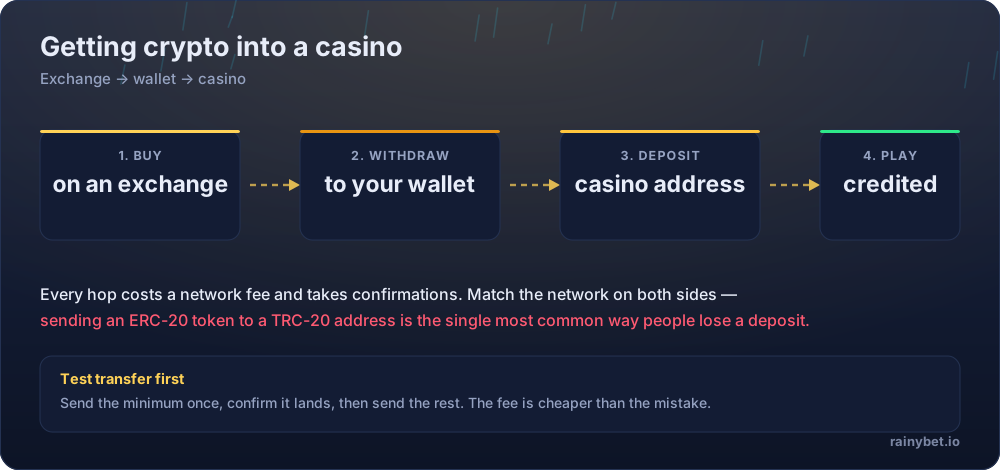
The three hops: exchange, wallet, casino
| Hop | What happens | What to check |
|---|---|---|
| Exchange | Buy crypto with local currency through a mainstream exchange | Verify the exchange supports withdrawals to external addresses, not just internal trading |
| Wallet (optional but recommended) | Move funds to a wallet where you hold the private keys | Confirm the wallet supports the specific coin and network you're using before sending |
| Casino deposit | Send from wallet (or directly from the exchange) to the casino's deposit address | Match the network exactly — this is where most deposit losses actually happen |
Some exchanges let you skip the middle hop and send straight from the exchange to a casino address. That's faster, but it means trusting the exchange's custody of your funds for longer and it removes a step where you'd otherwise double-check the network yourself. There's no universally correct answer here — it's a trade-off between speed and control.
The ERC-20 vs TRC-20 trap
Network mismatch happens when a token that exists on more than one blockchain — commonly a stablecoin like USDT on both Ethereum (ERC-20) and Tron (TRC-20) — gets sent on a different network than the receiving address expects.
This is the single most common way people lose a first deposit, and it has nothing to do with the casino being untrustworthy. Many popular tokens are issued on several blockchains at once, using the same or similar-looking token symbol. An address generated by a casino for TRC-20 deposits is a Tron address; sending ERC-20 tokens to it sends them on Ethereum, a network the casino's TRC-20 deposit system isn't watching at all. The funds don't arrive, and in most cases they can't be retrieved by anyone — not you, not support, not the exchange you sent them from.
Why this trap is so easy to fall into
The token often looks identical in your wallet regardless of which network it's on — same name, same symbol, sometimes the same icon. The network is a background detail unless you deliberately check it, which is exactly why it gets missed.
The fix is mechanical, not clever: read the network label on both the sending side and the receiving address before every transfer, not just the first one. Casinos and exchanges usually display it clearly once you know to look — the mistake happens when nobody looks.
Confirmations: why a deposit doesn't appear instantly
A confirmation is a block added to a blockchain after your transaction is included in it. Platforms typically wait for a set number of confirmations before treating a deposit as final, which is why funds don't always appear the instant you hit send.
How many confirmations a given casino waits for is set by that platform and the network in question — it is not a fixed, universal number we can quote across every operator and every coin. Networks also differ hugely in how fast a confirmation happens: some settle in seconds, others meaningfully longer. If a deposit hasn't appeared after a reasonable wait, check the transaction on a public block explorer before assuming something is wrong with the casino — the delay is very often just confirmations still accumulating.
Fees at every hop
A fee can apply at each of the three hops, and they are not the same kind of fee. The exchange typically charges a trading fee to buy the crypto and sometimes a separate withdrawal fee to move it out. The network itself charges a transaction fee to process the transfer, which varies with how congested that blockchain is at the time. Some casinos additionally apply their own deposit or withdrawal fee on top of the network fee — check for this specifically rather than assuming the network fee is the only cost.
None of these fees are fixed figures we can publish for every operator, since they change with network conditions and platform policy — check the cashier screen on your chosen casino for the current numbers.
Volatility: what a balance is worth by the time you spend it
Most cryptocurrencies move in price against local currency, sometimes substantially within a single day. A deposit converted to a stable local-currency value the moment you buy it can be worth a noticeably different amount by the time you actually wager it, purely from price movement — independent of anything the casino does and unrelated to the house edge covered in our house edge guide.
Using a stablecoin, where one exists and is supported, removes most of this specific risk, since stablecoins are designed to track a fiat currency closely. Using a volatile coin means accepting that your gambling budget is also, unavoidably, a small speculative position for as long as the balance sits unspent.
Custody basics: who actually holds your keys
Custody describes who controls the private keys to a crypto balance — you, in a wallet only you hold the keys to, or a third party, such as an exchange or a casino account.
Funds sitting on an exchange or inside a casino balance are held in the platform's custody, not yours, in the sense that matters technically: you don't hold the keys, the platform does. That's a normal and common arrangement, but it's worth being clear-eyed about — it means your access depends on that platform continuing to operate normally and honour withdrawals, not purely on cryptography you control directly. Moving funds through a wallet you hold the keys to, even briefly between exchange and casino, is the only point in the process where you have full custody yourself.
No chargeback: the irreversibility you're accepting
The plainest way to say this
A card payment can sometimes be disputed or reversed through a chargeback. A confirmed crypto transaction cannot. There is no bank to call, no dispute process and no support ticket that pulls funds back off a blockchain once a transaction has confirmed on the wrong network or to the wrong address.
This isn't a flaw specific to any casino — it's a basic property of how these networks work, and it's exactly why the network-matching step earlier in this guide matters more than any other single check in the deposit process. Sending a small test amount first, before the full deposit, costs one extra network fee and removes almost all of this risk.
A safer first-deposit checklist
Five steps that turn a first deposit from a leap of faith into a checked process
- Confirm which network the casino expects for your chosen coin before you buy or move anything.
Where people trip up: This is the check that prevents the ERC-20/TRC-20 trap — do it first, not as an afterthought.
- Buy the crypto on a mainstream exchange and, if you plan to hold it briefly, move it to a wallet you control.
Where people trip up: Skipping the wallet step is faster but keeps your funds in someone else's custody for longer.
- Send a small test amount to the casino deposit address first.
Where people trip up: A test transfer costs one network fee. A network mismatch on the full deposit costs the whole amount, with no way to reverse it.
- Confirm the test amount credits correctly before sending the rest.
Where people trip up: If it doesn't appear after a reasonable wait for confirmations, check a public block explorer before assuming the platform is at fault.
- Only then send the remainder of your intended deposit.
Where people trip up: Treat every subsequent deposit with the same network check — familiarity is exactly what causes people to stop looking.
Licence, geo-restrictions and playing safely
Licensing. Access is blocked in a number of countries and US states, and the list is maintained by the operator rather than published as a stable document. The current restricted list and licence details live on the operator’s own terms page — read them before you register.
Your side of it. Crypto casinos settle fast, which is exactly what makes them easy to overplay. Before your first deposit at these operators, set a deposit cap and a session timer in the account settings — not in your head.
- Deposit limits and self-exclusion tools live in account settings, not support chat
- A losing session is not a signal to raise the stake — it is a signal to stop
- Bonus turnover targets are not a reason to keep playing past your limit
- Free, confidential help: BeGambleAware and Gambling Therapy
Frequently asked questions
How do I buy crypto to use at a crypto casino?
Buy on a mainstream exchange with your local currency, move the coins to a wallet you control (or keep them on the exchange briefly), then send to the casino's deposit address on the network the casino specifies. Each hop — exchange, wallet, casino — is a separate step with its own fee and its own chance to make a network mistake.
What is the ERC-20 vs TRC-20 trap?
Many tokens exist on more than one blockchain network — commonly Ethereum (ERC-20) and Tron (TRC-20) for stablecoins like USDT. Sending funds on one network to a deposit address generated for the other typically results in a lost deposit, because the receiving platform is not watching that chain at all.
How many confirmations does a crypto deposit need?
It varies by network and by casino, and is not a fixed number we can quote for every operator. In general, the more confirmations a platform waits for, the safer the deposit is treated but the longer it takes to appear as spendable balance.
Why do I lose value just holding crypto before I gamble with it?
Because most cryptocurrencies are volatile against your local currency. A balance sitting in a wallet or casino account can be worth meaningfully more or less by the time you actually wager it, purely from price movement that has nothing to do with the casino or your play.
What does custody mean and why does it matter?
Custody describes who actually controls the private keys to crypto — you, an exchange, or a casino. Funds sitting on an exchange or inside a casino account are not fully in your control the way funds in a wallet where only you hold the keys are; that's the trade-off custody makes explicit.
Can I reverse a crypto deposit if I send it to the wrong address?
No. Crypto transfers are irreversible by design — there is no chargeback, no bank to call, and no support team that can pull funds back off a blockchain once a transaction confirms. This is the single biggest practical difference from a card deposit.
Are deposit fees the same as network fees?
Not necessarily. A network fee is paid to the blockchain itself to process the transaction; some casinos separately apply their own deposit or withdrawal fee on top. Check both before assuming the number quoted covers the full cost.