

On this page (10 sections)
Risk rows: what they actually change
Plinko is a ball-drop casino original where a player chooses a row count and a risk setting, then drops a ball that lands in one of several multiplier buckets at the base of the board.
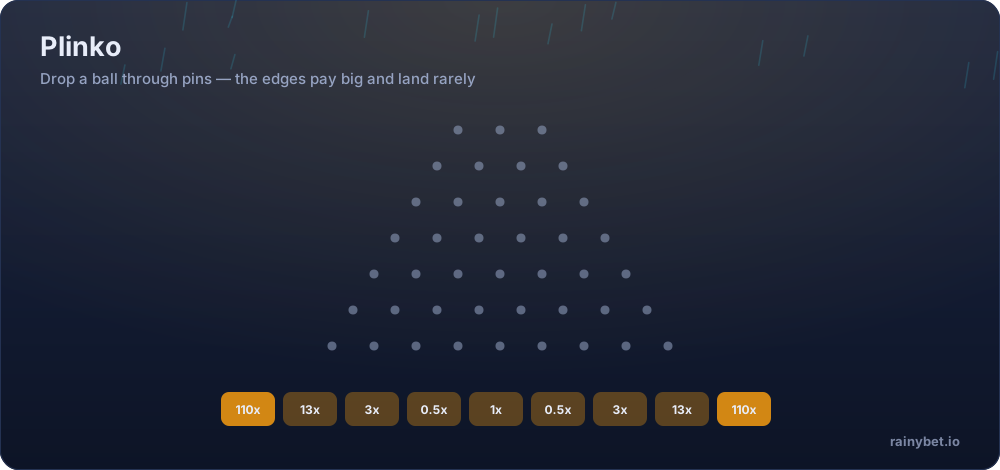
Adding rows or raising the risk setting widens the gap between the highest and lowest multiplier buckets. It reshapes where the probability mass sits across the board, not the underlying edge — a wider spread is not the same thing as better odds.
Variance in Plinko, session to session
Variance describes how widely individual outcomes swing around the long-run average — high-variance settings produce more extreme wins and losses per round, without changing the underlying house edge.
Plinko's ball-drop model spreads outcomes across many possible landing points, which is exactly what makes short sessions unreliable evidence about a setting's real performance. A handful of drops at a high-risk setting can look outstanding or disastrous purely from short-run variance, independent of the long-run edge underneath it.
The tell that separates variance from edge
If a setting only looks good over ten drops, that's variance talking. The house edge only becomes visible over enough rounds for the law of large numbers to apply — usually far more than a single session provides.
The edge-bucket trap
This is the specific mistake volume players fall into: judging a risk setting by a recent hot streak in the high-multiplier buckets, then assuming that setting is simply 'better' going forward. The house edge sits underneath every setting regardless of which bucket a recent run happened to land in.
Do the arithmetic before chasing a bucket
A higher risk setting generally means a wider edge, and rakeback is charged on that edge — so chasing bucket variance for its own sake can quietly cost more in expected value than it returns in rakeback speed. Run the numbers yourself →
This is the same trap in different clothing as the high-edge chase covered on our Rainbet games overview — a wider spread is not free, and rakeback discounts the edge, it never reverses it.
How Plinko multipliers are structured
Generally, the centre buckets on any Plinko-style board land most often and pay the smallest multipliers, while the outer edge buckets land rarely and pay the largest. That shape is a mathematical property of the ball-drop model itself, not something specific to one operator's implementation.
| Setting | Typical spread | Landing frequency in outer buckets |
|---|---|---|
| Low risk | Narrow — outcomes cluster near the middle | Rare |
| Medium risk | Moderate spread | Occasional |
| High risk | Wide — small and huge multipliers both possible | Rarer still, but higher-paying when hit |
How to play Plinko step by step
Three steps, repeated at whatever pace you choose
- Set your stake, choose a row count and a risk setting.
Where people trip up: Start on low or medium risk until you've watched enough drops to understand the bucket layout.
- Drop the ball and let the round resolve.
Where people trip up: There is nothing to influence once the ball is dropped — the outcome is fully determined at that point.
- Review where it landed and adjust your next stake or setting deliberately.
Where people trip up: Adjusting settings reactively after one drop is exactly the edge-bucket trap described above — decide your approach before the session, not between drops.
Bankroll sizing for high-variance rows
Higher risk settings demand a larger bankroll relative to your stake size simply to survive the wider swings without being forced to stop at the worst possible moment. Our bankroll management guide covers general sizing principles that apply directly here, and the Plinko simulator lets you see the swings play out with no funds actually at risk.
Is Plinko provably fair?
Yes — the ball's drop path is generated with the same commit-reveal mechanism used across Rainbet's Originals. The path is committed to before you drop, and the seed can be revealed and re-hashed afterward to confirm it. See our Rainbet provably fair guide for the exact verification steps.
Honest pros and cons
What works about Rainbet
- Single, clean decision per round with no ongoing skill requirement
- Provably fair and verifiable after the fact
- Adjustable risk lets a player match variance to their own bankroll size
- A free simulator exists to see the bucket spread before wagering
What to weigh up first
- High-risk settings carry variance that can look like a better edge over a short session and isn't
- Exact payout tables and house edge per setting aren't published as fixed figures here — check the game's own rules screen
- The edge-bucket trap is a genuinely easy mistake to make without deliberate discipline
Licence, geo-restrictions and playing safely
Licensing. Access is blocked in a number of countries and US states, and the list is maintained by the operator rather than published as a stable document. The current restricted list and licence details live on the operator’s own terms page — read them before you register.
Your side of it. Crypto casinos settle fast, which is exactly what makes them easy to overplay. Before your first deposit at Rainbet, set a deposit cap and a session timer in the account settings — not in your head.
- Deposit limits and self-exclusion tools live in account settings, not support chat
- A losing session is not a signal to raise the stake — it is a signal to stop
- Bonus turnover targets are not a reason to keep playing past your limit
- Free, confidential help: BeGambleAware and Gambling Therapy
Frequently asked questions
What do the risk rows in Rainbet Plinko actually change?
The number of rows and the risk setting together determine the spread of the multiplier buckets — how extreme the highest and lowest outcomes can be, and how the probability mass is distributed between them. Higher risk widens that spread; it does not change the underlying house edge in your favour.
Why does Plinko feel so different session to session at the same settings?
Plinko is high-variance by design: the physical drop model spreads outcomes across many possible buckets, so short sessions can look very different from the long-run average even with identical settings every time.
What is the edge-bucket trap in Plinko?
It's the mistake of judging a risk setting by a handful of sessions rather than its long-run edge. A high-risk setting can produce a lucky short-run streak that looks like a better setting, when the actual house edge sits at the same place regardless of the streak.
Is high-risk Plinko a good strategy for high-volume players?
It increases variance, not expected value. For a volume player optimising rakeback speed, a higher setting may accrue rakeback faster on a wider edge, but the increased variance also means larger, more painful drawdowns along the way.
Is Rainbet Plinko provably fair?
Yes. The ball drop path is generated using the same commit-reveal system as Rainbet's other Originals, which can be checked after the fact against the seed committed before you played.
How much bankroll should I set aside for high-risk Plinko?
There's no fixed answer we can quote for Rainbet, but the general principle of bankroll management applies more urgently at higher variance settings — see our bankroll management guide for the reasoning.