

On this page (6 sections)
Mines as an Originals RTP question
Mines is a grid-reveal casino original, not a reel slot: a player chooses a grid size and a hidden bomb count, then reveals tiles one at a time for a rising multiplier, cashing out before hitting a bomb or forfeiting the round if they do.
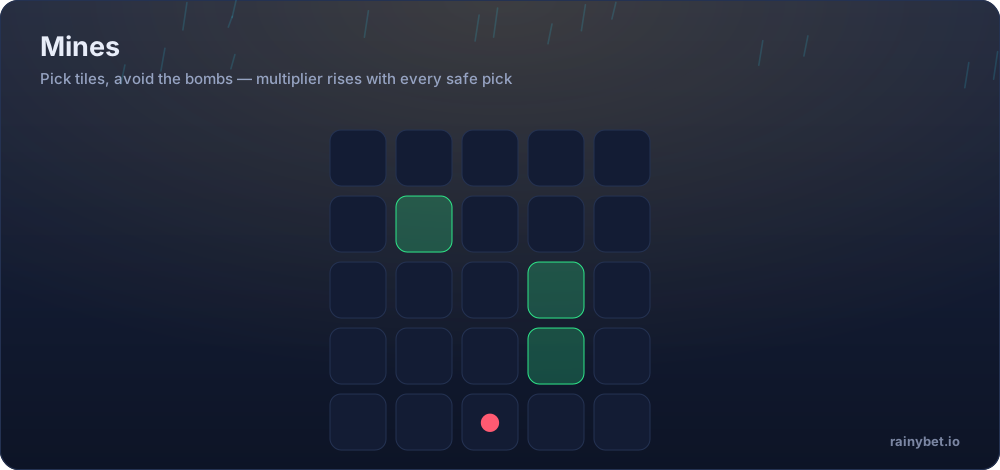
Reel slots hide their exact weighting behind a paytable and a published RTP figure you have to trust. Mines is built differently: its multiplier at every step is a combinatorial calculation anyone can verify by hand, which makes it a genuinely useful case study for what 'RTP' means once you strip away the marketing layer.
How the multiplier is derived, step by step
At any point in a round, the fair odds of the next reveal being safe are the count of remaining safe tiles divided by the count of remaining unrevealed tiles. The fair multiplier for a round is the running product of the inverse of that probability, across every safe reveal completed so far:
fair multiplier after n reveals = ∏ (tiles remaining at step i) / (safe tiles remaining at step i)
A worked, illustrative example
On a 25-tile grid with 3 bombs, the first reveal has 22 safe tiles out of 25 unrevealed — a fair multiplier contribution of 25/22. By the fifteenth safe reveal, only 7 safe tiles remain out of 10 unrevealed, a contribution of 10/7 on top of everything already accumulated. Multiply every step's contribution together and the round's fair multiplier climbs steeply toward the end — exactly matching the rising bust risk. This illustrates the general mechanic; Rainbet's specific weighting table is not published as a fixed figure.
The number actually shown in the game applies an operator house-edge discount on top of that fair figure — the same idea our house edge explained guide covers for RTP generally. The combinatorial shape above is public maths; the specific discount factor is set by the operator and not published as a fixed number.
What actually decides the effective RTP
Three things determine what a Mines round actually returns on average, and only one of them is set by the operator rather than the player:
| Factor | Who controls it | What it changes |
|---|---|---|
| Bomb count | Player, chosen before the round | Steepness of the multiplier curve and bust risk per reveal — variance, not the edge |
| Number of reveals before cash-out | Player, chosen during the round | How much of the curve you're exposed to — variance, not the edge |
| Operator weighting applied on top of the fair odds | Operator, fixed and not published as a public table | The actual house edge baked into every reveal |
It's tempting to read 'more control over bomb count and stop point' as 'more control over the edge.' It isn't. Bomb count and stop point change how spread out your outcomes are — a gentler curve with more, smaller wins versus a steeper curve with rarer, bigger ones — while the operator's underlying weighting stays fixed underneath every setting you choose.
What bomb count and stop point change (and what they don't)
The one sentence worth remembering
Mines' effective RTP in the sense of 'what does this round return on average' is player-influenced in that bomb count and stop point reshape variance. The underlying edge itself is fixed by the operator's weighting, not by anything the player selects — no bomb count or stop point turns a negative-expectation game into a positive one.
| Bomb count | Typical feel | Best suited to |
|---|---|---|
| Low (1-3 on a large grid) | Gentle multiplier growth, lower bust risk per reveal | Learning the mechanic, smaller bankroll swings |
| Medium | Faster multiplier growth, meaningfully higher bust risk | Players comfortable with the curve already |
| High | Steep multiplier growth, high bust risk per reveal | Deliberate high-variance sessions only |
For real-money play, activation steps, and the full pros-and-cons breakdown of the mechanic, see our Rainbet Mines guide, which covers the same combinatorial idea alongside bonus terms and provably fair verification.
Test it yourself before wagering anything
Our Mines simulator runs this exact combinatorial formula on a live 5×5 grid with a house-edge input you set yourself, so you can watch the curve build in real time and test different bomb counts with zero funds at risk before ever touching a real balance.
Licence, geo-restrictions and playing safely
Licensing. Access is blocked in a number of countries and US states, and the list is maintained by the operator rather than published as a stable document. The current restricted list and licence details live on the operator’s own terms page — read them before you register.
Your side of it. Crypto casinos settle fast, which is exactly what makes them easy to overplay. Before your first deposit at Rainbet, set a deposit cap and a session timer in the account settings — not in your head.
- Deposit limits and self-exclusion tools live in account settings, not support chat
- A losing session is not a signal to raise the stake — it is a signal to stop
- Bonus turnover targets are not a reason to keep playing past your limit
- Free, confidential help: BeGambleAware and Gambling Therapy
Frequently asked questions
Is Mines a slot?
No — Mines is a casino Original: a grid-reveal game rather than a spinning-reel slot. We cover its RTP here because readers researching 'slot RTP' are often asking a broader question about any RNG casino game's odds, and Mines is one of the few where the underlying formula can be shown in full rather than hidden behind a paytable.
How is the Mines multiplier actually derived?
As a running product: before each reveal, the fair odds of that reveal being safe are the count of remaining safe tiles divided by the count of remaining unrevealed tiles. Multiply that ratio across every safe reveal so far and you get the fair combinatorial multiplier for the round, before any house-edge discount is applied on top.
Does the bomb count change the effective RTP?
It changes variance, not the underlying edge. A higher bomb count produces a steeper multiplier curve and a higher chance of an early bust, but the operator's fixed weighting still applies the same discount proportionally — it doesn't hand you better long-run odds for choosing more bombs.
Does choosing when to cash out change my odds?
It changes how much variance you're exposed to in a given round, not the edge itself. Cashing out earlier locks in a smaller, more certain multiplier; playing further locks in a larger multiplier at a higher bust risk. Neither choice makes the underlying weighting more favourable.
What is Rainbet's exact Mines weighting table?
Not published as a fixed, quotable figure. The general combinatorial shape of the maths is public and explained on this page; the specific discount Rainbet applies on top of it is not.
Is Mines provably fair?
Yes — the bomb layout is committed to (hashed) before you play and the underlying seed can be revealed and re-hashed afterward to confirm it matches the original commitment. See our Rainbet provably fair guide for the verification steps.
Can I test bomb counts without risking money?
Yes. Our Mines simulator runs the exact combinatorial formula this page describes, with a house-edge input you control and no funds at stake, so you can watch different bomb counts play out before wagering anything real.