

On this page (6 sections)
Plinko as an Originals RTP question
Plinko is a casino original where a ball drops through a peg board with a chosen row count, bouncing left or right at each peg before landing in one of several payout buckets at the base.
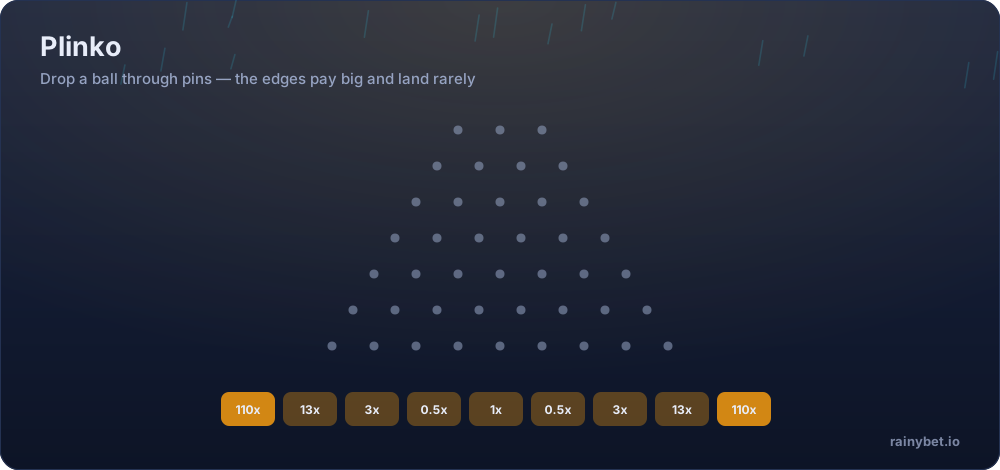
Reel slots publish an RTP figure and keep the paytable weighting behind it private. Plinko is different: the probability of landing in any given bucket follows a well-known formula that can be stated exactly, which makes it a useful case for seeing how an edge-weighted payout table is actually constructed.
The binomial distribution behind bucket landings
Each peg is an independent, fair coin flip — bounce left or bounce right, each with probability 0.5. After n rows, the bucket a ball lands in is the count of 'right' bounces, k, out of n total. The probability of landing in bucket k is the standard binomial formula:
P(k) = C(n, k) / 2n
A concrete number
At 16 rows, the centre bucket (8 right-bounces out of 16) has a binomial probability of about 19.6% — nearly one drop in five. The outermost bucket has a probability of roughly 0.0015%, about one drop in sixty-five thousand. Same board, same fair coin flips, wildly different odds by position — this is general binomial maths, not a claim about any specific operator's numbers.
How an edge-weighted payout table is built
The binomial probabilities above are fixed by row count alone and never change. What an operator controls is the payout multiplier assigned to each bucket, built by taking a raw payout shape — larger multipliers further from the centre — and scaling the whole table so its expected value lands at the intended edge.
| Risk level | General effect on the payout shape | What stays fixed |
|---|---|---|
| Low | Flatter table, small gap between best and worst bucket | Binomial landing probabilities, set only by row count |
| Medium | Moderate spread, noticeable edge-bucket premium | Binomial landing probabilities, set only by row count |
| High | Steep spread, edge buckets pay dramatically more, centre pays little | Binomial landing probabilities, set only by row count |
This is the same balancing act every edge-weighted payout table performs: a bucket landed in rarely needs a proportionally larger multiplier just to contribute its fair share to the table's overall expected value, or the table's advertised edge wouldn't hold together.
What decides the effective RTP here
| Factor | Who controls it | What it changes |
|---|---|---|
| Row count | Player, chosen before the drop | Number of buckets and how spread out the distribution is — variance, not the edge |
| Risk level | Player, chosen before the drop | How payout weight is distributed between centre and edge buckets — variance, not the edge |
| Payout table construction | Set by the operator — not published as a fixed table | The actual expected value of the whole table |
The one sentence worth remembering
Which bucket a specific ball lands in is genuinely random and independent of every previous drop. The effective RTP of the game depends on how the operator built the payout table against that binomial spread — not on the row count or risk level you selected, which only reshape variance.
For the real-money mechanic, activation steps and the edge-bucket trap that catches volume players chasing a recent streak, see our Rainbet Plinko guide and Roobet Plinko guide.
Test it yourself before wagering anything
Our Plinko simulator drops play-money balls through a live board, tracking your observed bucket landings against the exact binomial probability for each one in real time — the fastest way to watch convergence happen instead of taking it on faith.
Licence, geo-restrictions and playing safely
Licensing. Access is blocked in a number of countries and US states, and the list is maintained by the operator rather than published as a stable document. The current restricted list and licence details live on the operator’s own terms page — read them before you register.
Your side of it. Crypto casinos settle fast, which is exactly what makes them easy to overplay. Before your first deposit at Rainbet, set a deposit cap and a session timer in the account settings — not in your head.
- Deposit limits and self-exclusion tools live in account settings, not support chat
- A losing session is not a signal to raise the stake — it is a signal to stop
- Bonus turnover targets are not a reason to keep playing past your limit
- Free, confidential help: BeGambleAware and Gambling Therapy
Frequently asked questions
Is Plinko a slot?
No — Plinko is a casino original built around a ball drop through a peg board, not spinning reels. We cover its RTP here because readers researching 'slot RTP' are often asking a broader question about any RNG casino game's odds, and Plinko's binomial structure can be explained in full where a slot's paytable usually can't.
Why does the ball land in the middle buckets most often?
Every peg is an independent 50/50 bounce, and the final bucket is just the count of 'right' bounces out of all the rows. With many independent coin-flip-style events, the most common total sits near half of them, which is why the centre buckets are hit far more often than the edges.
What actually decides Plinko's effective RTP?
The edge-weighted payout table constructed against the binomial landing probabilities, not the risk setting on its own. Risk level reshapes how that payout weight is distributed across buckets; the operator's fixed table design is what sets the actual expected value.
Does a higher risk setting improve my odds?
No. Higher risk widens the gap between the smallest and largest payouts — more extreme wins and losses — without changing the underlying expected value the table was built to deliver.
What is the published paytable for a specific operator's Plinko?
Not something we can quote as a fixed figure here. The general binomial-and-edge-weighting method behind any Plinko-style paytable is public maths; the exact numbers an operator sets are not published in a form we can verify.
Is Plinko provably fair?
Yes, at most crypto casinos. The ball's drop path is generated using a commit-reveal system: committed to before the drop and revealed afterward so the outcome can be independently checked. See our Rainbet Plinko guide for verification steps.
Can I test row counts and risk settings without risking real money?
Yes. Our Plinko simulator runs a live binomial distribution with a house-edge input and a real-time observed-vs-expected comparison table, so you can test settings with zero funds at risk.