

On this page (6 sections)
Crash as an Originals RTP question
Crash is a casino original where a multiplier rises from 1x in real time until it hits an unpredictable bust point; players must cash out before the bust to win their stake times the multiplier at cash-out, or lose the stake entirely.
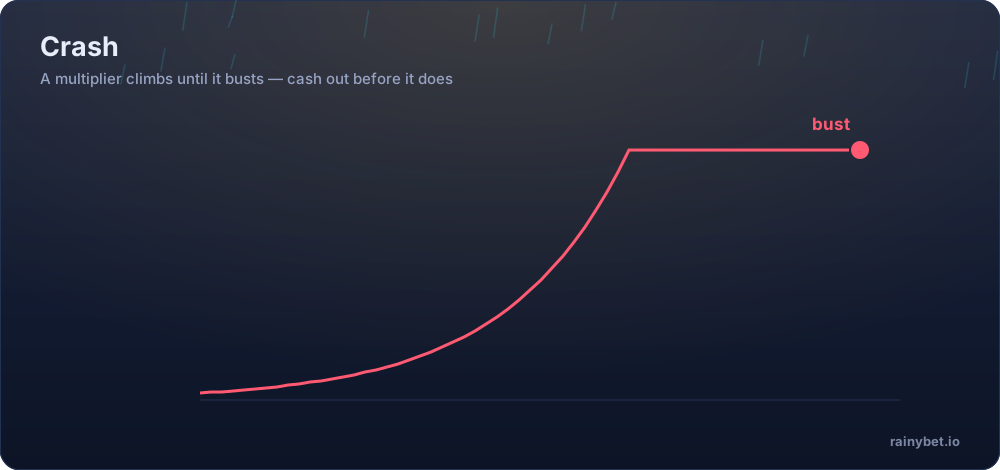
Reel slots publish an RTP figure and keep the exact weighting behind it private. Crash is built differently: the shape of its bust-point distribution can be stated and reasoned about directly, which makes it a useful case for understanding what 'RTP' actually depends on once the marketing layer is stripped away.
The distribution shape behind the bust point
A Crash-style bust point is drawn from a distribution engineered so the chance of reaching at least multiplier x is proportional to 1/x, scaled by the edge parameter. That single design choice is what makes every cash-out target land on the same expected value:
P(bust point ≥ x) = (1 − edge) / x
Why the shape, not the number, is the point
This is the general inverse-CDF construction behind provably fair crash games as a category. The specific edge parameter live at any given operator is not published as a fixed figure we can quote here. Our Crash simulator lets you set that edge input yourself and watch the shape play out over a batch of simulated rounds.
Our house edge explained guide covers the same edge-versus-RTP arithmetic in a slot context — the relationship (edge = 100% minus RTP) doesn't change just because the mechanic is a rising multiplier instead of spinning reels.
What decides the effective RTP here
| Factor | Who controls it | What it changes |
|---|---|---|
| Cash-out target chosen | Player, set before or during the round | How often you win and how much each win pays — variance, not the edge |
| Auto-cashout on or off | Player | Removes reaction time as a variable — no effect on expected value |
| Edge parameter in the bust-point distribution | Operator, fixed and not published as a specific figure | The actual long-run expected return of every possible strategy |
A low target hits often and pays a little; a high target hits rarely and pays a lot. Both are drawing from the same distribution with the same edge parameter underneath, so both converge on the same expected return over enough rounds — the target changes the shape of your outcomes, not their average.
Why no cash-out target is mathematically better
The one sentence worth remembering
Effective RTP in Crash is fixed by the edge parameter inside the distribution, not by the cash-out target a player chooses. Picking 1.5x over 10x changes how often you win and how big each win is; it does not change your long-run expected return under the same edge.
For the real-money mechanic, provably fair verification steps, and the psychology of the 'one more round' trap that Crash's fast pace encourages, see our Roobet Crash guide and BC.Game Crash guide — both cover the same distribution idea alongside each operator's bonus terms.
Test it yourself before wagering anything
Our Crash simulator runs this exact inverse-CDF formula with an adjustable house-edge input and a 1,000-round batch mode, letting you compare very low and very high cash-out targets side by side with zero funds at risk.
Licence, geo-restrictions and playing safely
Licensing. Access is blocked in a number of countries and US states, and the list is maintained by the operator rather than published as a stable document. The current restricted list and licence details live on the operator’s own terms page — read them before you register.
Your side of it. Crypto casinos settle fast, which is exactly what makes them easy to overplay. Before your first deposit at Roobet, set a deposit cap and a session timer in the account settings — not in your head.
- Deposit limits and self-exclusion tools live in account settings, not support chat
- A losing session is not a signal to raise the stake — it is a signal to stop
- Bonus turnover targets are not a reason to keep playing past your limit
- Free, confidential help: BeGambleAware and Gambling Therapy
Frequently asked questions
Is Crash a slot?
No — Crash is a casino Original built around a rising multiplier and an unpredictable bust point, not spinning reels. We cover its RTP here because readers researching 'slot RTP' are often asking a broader question about any RNG casino game's odds, and Crash is one of the few whose distribution shape can be shown in full.
What actually decides Crash's effective RTP?
The edge parameter built into the bust-point distribution, not the cash-out target you choose. A crash-point distribution is constructed so that every possible cash-out target converges on the same expected value, set entirely by that fixed edge parameter.
Does a low cash-out target 'beat' a high one?
No. A low target (say 1.5x) hits often and pays little each time; a high target (say 10x) hits rarely and pays a lot when it does. Both converge on the same long-run expected value under the same edge parameter — neither is mathematically better.
What is the published house edge for Crash?
Operators generally don't publish a single fixed edge figure for Crash that we can quote here. Provably fair verification confirms the round wasn't tampered with independently of any specific edge number.
Does auto-cashout change the odds?
No. Auto-cashout removes reaction time from the equation — the round exits automatically at your target the instant it's reached, if it's reached before the bust point. The underlying distribution, and therefore the expected value, is identical with or without it.
Is Crash provably fair?
Yes, at most crypto casinos. The crash point for each round is derived from a server seed committed before betting opens and revealed afterward, so it can be independently verified. See our Roobet Crash guide for the verification steps.
Can I test cash-out targets without risking real money?
Yes. Our Crash simulator runs the exact inverse-CDF formula this page describes, with a house-edge input and a 1,000-round batch mode, so you can see how different targets converge before wagering anything real.