

On this page (13 sections)
Auto-cashout: the maths, not the feeling
Set an auto-cashout target and the round exits for you at that multiplier, every time, without hesitation. The value of doing this is not emotional — it is that a pre-committed number cannot be talked out of itself mid-round the way a live decision can.
Auto-cashout is a pre-set multiplier target that exits a Crash bet automatically once the rising multiplier reaches it, removing the need for a manual, real-time reaction as the round plays out.
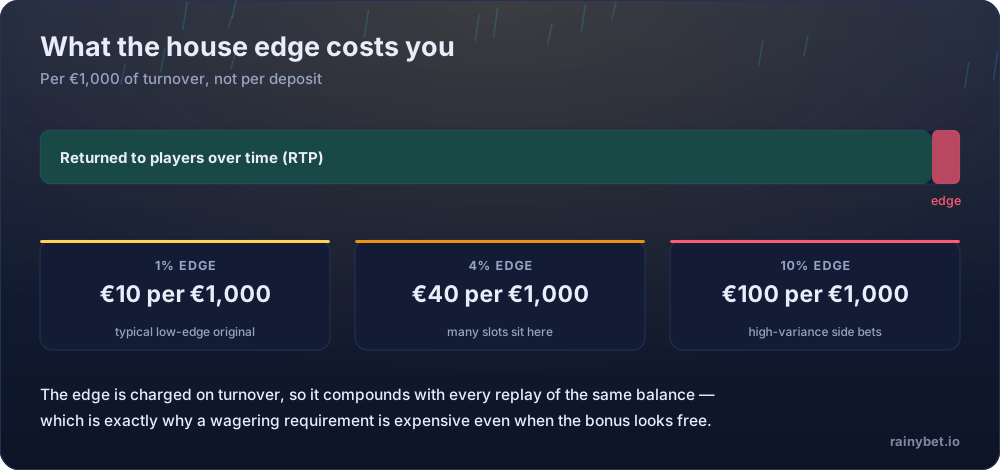
A low target — say, cashing out at 1.5x — hits often and pays little each time. A high target hits rarely and pays a lot when it does. Neither is inherently better; both converge on the same long-run expectation, because the crash point distribution does not care what number you picked.
How Roobet Crash actually works
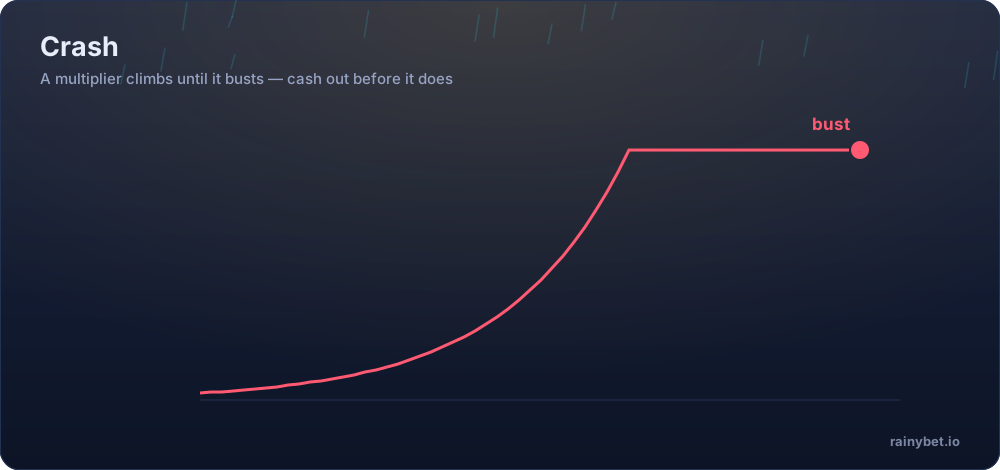
You place a bet before the round starts. A multiplier then climbs from 1x in real time. At some point, unknown in advance, it crashes. If you cashed out before that moment, you win your stake times the multiplier at cash-out. If not, the entire bet is lost — there is no partial credit for a near-miss.
Variance and bankroll ruin, in plain numbers
Crash's variance comes from the shape of its payout distribution: most rounds crash early at low multipliers, and a small number run very high. That shape means a string of small losses punctuated by rare large wins is the normal pattern, not a sign anything is wrong.
Bankroll ruin in any high-variance game follows the same general principle: the size of your bet relative to your total bankroll determines how many losing rounds in a row you can survive before you are forced out entirely. Doubling your stake after a loss to 'get back to even' — a martingale-style approach — raises the size of that risk exponentially with each repeat, because the losing streak length needed to wipe you out gets shorter every time you double.
Model it before you bet it
Our EV and Kelly calculator and bankroll management guide both walk through bet-sizing maths with your own bankroll figures, not a generic example.
Why 'one more round' is the trap
Watching a multiplier climb past your cash-out point after you already exited feels like a loss, even though it was a win. Watching it crash one tick after you would have cashed out feels like a near-win, even though it was a full loss. Neither feeling reflects the actual outcome, and both push toward the same next move: one more round to 'fix' it.
The pattern to recognise in yourself
If your stated reason for the next bet is a previous round rather than your original plan, that is the signal to stop, not to continue. Crash's round length — seconds, not minutes — makes this pattern easier to fall into than almost any other casino game.
Provably fair verification on Crash
Provably fair verification lets a player independently confirm a round's outcome was fixed before betting opened, rather than trusting the operator's word alone — done by rotating a client seed and re-hashing the revealed server seed against the commitment shown before the round.
The crash point for each round is derived from a server seed committed before betting opens. Reveal and re-hash it afterward, and a match confirms the outcome was fixed in advance of your wager, not adjusted in response to it. Full steps: Roobet provably fair guide.
ROOSPINS and Crash: does the cashback help?
Crash's high round-per-minute rate generates turnover fast, but ROOSPINS pays cashback on net loss, not on volume — so a run of small wins offset by one large loss can return less cashback than the size of that loss would suggest, and game weighting is not published as a fixed table here — check your account before assuming Crash counts the same as other titles.
Bonus terms in one table
| Term | What applies |
|---|---|
| Bonus code | ROOSPINS |
| What the code unlocks | 20% Cashback for 7 Days |
| Offer type | Time-boxed cashback |
| Minimum qualifying deposit | Set in the cashier — shown at deposit |
| Wagering requirement | Set out in the operator’s bonus terms |
| Maximum bet while bonus is active | Defined in the bonus terms — check before staking up |
| Bonus validity window | Stated on the promotion page at activation |
| Game weighting | Published in the operator’s weighting table |
| Maximum cashout from bonus funds | Capped per the bonus terms where a cap applies |
| Sticky or non-sticky | Declared in the bonus terms per offer |
Fine print specific to Crash
The small print on Roobet — read this part twice
- No partial payout on a missed cash-out. The entire stake is lost if you cash out even a fraction of a second after the crash.
- Auto-cashout does not change the odds. It removes reaction time as a variable, nothing more.
- Maximum bet is not a fixed published figure. Confirm the live limit in the game window before sizing a large stake.
- Cashback rewards net loss, not turnover. High round volume on Crash does not translate directly into proportional cashback.
- Martingale-style recovery betting compounds risk fast. Doubling after a loss is a bankroll strategy, not a way to beat the underlying edge.
Terms are the operator’s to change. If a clause below no longer matches what you see in your account, the account version wins — and we want to hear about it.
Testing a cash-out strategy safely
Four steps, and the simulator step is the one to actually do first
- Pick an auto-cashout target and test it against thousands of simulated rounds first, with no real money at stake, using the Crash simulator.
Where people trip up: A target that looks good after ten rounds can look very different after ten thousand — variance needs volume to average out.
- Decide your stop-loss for the session before you play a single real round.
Where people trip up: The decision is easy to make in advance and hard to make after two losses in a row — make it in advance.
- If you decide to deposit and play for real, register with
ROOSPINSattached and confirm it in your promotions panel first. Open RoobetWhere people trip up: The code is signup-only in almost every case — add it before you register, not after.
- Set your auto-cashout target in the game interface and stick to it for the session.
Where people trip up: Changing your target mid-session after a near-miss is the exact pattern this guide warns against.
Honest pros and cons
What works about Roobet
- Auto-cashout removes reaction time as a variable, which is genuinely useful
- Provably fair verification is straightforward to run on a fast-round game
- Simple single-decision format makes bankroll math easy to model in advance
- A free simulator exists to test targets before risking real funds
What to weigh up first
- No partial payout for a near-miss — the entire stake is lost either way
- Round speed makes 'one more round' easier to fall into than almost any other game
- Cashback rewards net loss, undercutting a high-volume Crash-specific strategy
- Maximum bet is not a fixed published figure — check the live limit in the game window
Who Crash actually suits
Suits players who commit to an auto-cashout target and a stop-loss before the session starts, and who treat every round as independent of the last. Does not suit anyone prone to chasing a near-miss — which the round-per-minute pace of Crash makes an easy habit to slip into.
Licence, geo-restrictions and playing safely
Licensing. Access is blocked in a number of countries and US states, and the list is maintained by the operator rather than published as a stable document. The current restricted list and licence details live on the operator’s own terms page — read them before you register.
Your side of it. Crypto casinos settle fast, which is exactly what makes them easy to overplay. Before your first deposit at Roobet, set a deposit cap and a session timer in the account settings — not in your head.
- Deposit limits and self-exclusion tools live in account settings, not support chat
- A losing session is not a signal to raise the stake — it is a signal to stop
- Bonus turnover targets are not a reason to keep playing past your limit
- Free, confidential help: BeGambleAware and Gambling Therapy
Frequently asked questions
How does Roobet Crash work?
A multiplier starts at 1x and rises until it crashes at an unpredictable point. You bet before the round starts and must cash out before the crash — miss the window and the bet is lost in full, regardless of how high the multiplier had climbed.
What is auto-cashout on Crash?
A pre-set multiplier at which the game cashes your bet out automatically, removing the need to react in real time. It does not change the underlying odds — it changes whether you are the one deciding, or a rule you set in advance.
Is Roobet Crash provably fair?
Yes. Each round's crash point is derived from a server seed committed before betting opens and revealed afterward, so you can verify it was not altered once wagers were placed. See our Roobet provably fair guide.
What is the house edge on Roobet Crash?
Roobet does not publish a single fixed edge figure for Crash that we can quote here — check the game's own info panel for the live figure. Provably fair verification confirms fairness independently of any specific edge number.
Why do people lose more on Crash than other games?
Because a near-miss still returns nothing. Watching a multiplier reach 9x and crash before you clicked cash-out feels different from a slow grind loss, and that feeling is exactly what drives the 'one more round' pattern.
Does the ROOSPINS cashback apply to Crash losses?
Game weighting for cashback is not published as a fixed table. Confirm in your account before assuming Crash volume counts the same as any other title.
What is the safest way to test a Crash strategy?
Use a simulator with no real money at stake before wagering. Our Crash simulator lets you test auto-cashout targets against thousands of simulated rounds first.