
On this page (11 sections)
Trust signals compared: Shuffle vs Rainbet vs Stake
"Is it legit" is not a single checkbox. It breaks down into licensing, whether outcomes are independently verifiable, and whether payout behaviour matches what the operator claims. Here is how the three brands stack up on the signals that actually matter.
 Shuffle Shuffle |  Rainbet Rainbet |  Stake Stake | |
|---|---|---|---|
| Provably fair games | Yes, verifiable per round | Yes, verifiable per round | Yes, verifiable per round |
| Licence detail published here | Listed on the operator's licensing page | Listed on the operator's licensing page | Listed on the operator's licensing page |
| Restricted jurisdictions | Maintained in the operator's terms — varies by region | Maintained in the operator's terms — varies by region | Maintained in the operator's terms — varies by region |
| Bonus mechanic transparency | Deposit match, wagering terms apply | Rakeback boost, terms partly published | Rakeback unlock, terms partly published |
| Public track record length | Not published as a fixed figure | Newer but fast-growing, crypto-native | Established, most-cited benchmark in the category |
Notice what that table does not show: a single winner. All three run comparable provably fair systems, and none of the three publish a full, quotable restricted-country list on their marketing pages. The differences that actually separate them live in bonus mechanics and catalogue maturity, covered on our Shuffle review and Rainbet vs Stake pages.
What 'legit' actually means for a crypto casino
For a crypto casino, legit generally means three things hold together: the operator holds a real gambling licence, its games can be independently verified as unmanipulated, and withdrawals process as described in its own terms.
It does not mean risk-free. Even a fully legitimate operator runs games with a built-in house edge, and crypto settlement removes any chargeback safety net. "Legit" answers whether the operator is who it claims to be and plays by its own stated rules — not whether gambling there is a good financial decision for you personally.
Licensing and geo-restrictions
What we can confirm about Shuffle's licensing
- Licence number & authority
- Listed in the operator's site footer
- Full restricted-country list
- Maintained in the operator's terms — varies by region
- KYC trigger for withdrawal
- Applied at the operator's discretion — triggers are not published
Why this table is mostly amber
Licence numbers and full restricted lists are not published by any of the three operators as a single, stable, quotable document at the time of writing. The honest position is to flag that rather than repeat a number we cannot verify. Check the operator's own footer or licensing page directly before depositing.
Provably fair — the part you can check yourself
Provably fair is the strongest concrete trust signal available to a player, because it does not require trusting the operator's word at all. The system commits to a server seed before you play; you supply or rotate a client seed; after the round, you reveal the server seed and re-hash it against the original commitment.
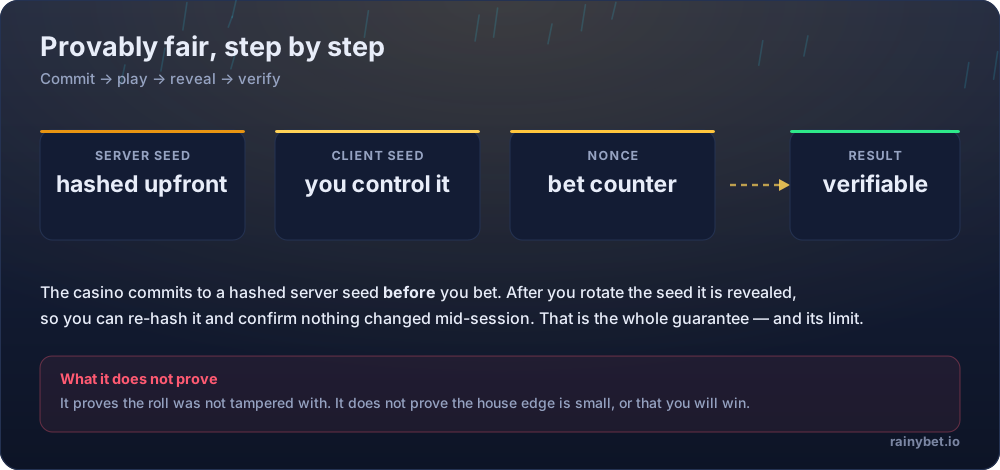
If the hash matches, the round could not have been altered after you placed your stake. This works identically across Shuffle, Rainbet and Stake, since the technique is a category standard rather than a proprietary feature of any one brand.
Key terms in one table
| Term | What applies |
|---|---|
| Bonus code | SHFLVIP |
| What the code unlocks | 200% Deposit Bonus Up to $1,000 |
| Offer type | Deposit match |
| Minimum qualifying deposit | Set in the cashier — shown at deposit |
| Wagering requirement | Set out in the operator’s bonus terms |
| Maximum bet while bonus is active | Defined in the bonus terms — check before staking up |
| Bonus validity window | Stated on the promotion page at activation |
| Game weighting | Published in the operator’s weighting table |
| Maximum cashout from bonus funds | Capped per the bonus terms where a cap applies |
| Sticky or non-sticky | Declared in the bonus terms per offer |
The fine print that trips people up
The small print on Shuffle — read this part twice
- Provably fair only covers Originals-style games. Third-party slots and live tables rely on the studio's own certification instead, a different trust chain entirely.
- A licence claim is only as good as its source. Verify licensing directly on the operator's own site footer, not through a third-party summary — including this one.
- Clone sites are the real legitimacy risk. A domain that looks identical to the real one is the most common way a legitimate operator gets used against a player.
- Restricted jurisdictions still apply even to a fully licensed operator — the current list lives in the operator's terms and changes without notice.
- Payout speed varies by size and review stage. A legitimate operator can still take longer than expected on a large first cashout.
Terms are the operator’s to change. If a clause below no longer matches what you see in your account, the account version wins — and we want to hear about it.
How to verify a Shuffle round yourself
Four steps, and you never had to trust a claim — only arithmetic
- Play a round on a provably fair game with your client seed set.
Where people trip up: Note the round's server seed hash, shown before you bet — that is the commitment.
- After the round, rotate your client seed or request the server seed reveal.
Where people trip up: Rotating the seed is usually what triggers the reveal of the previous one.
- Take the revealed server seed and hash it yourself using the same algorithm the operator states.
Where people trip up: Third-party independent hash tools exist precisely so you do not have to trust the operator's own verifier page.
- Compare your hash to the commitment shown before the round.
Where people trip up: A match confirms the outcome was fixed before your stake was placed, not adjusted afterward.
Honest pros and cons
What works about Shuffle
- Provably fair verification gives a concrete, checkable trust signal, not just a claim
- Standard crypto rails and open operation, consistent with the category norm
- A deposit match code costs nothing to enter and carries no phishing risk of its own
What to weigh up first
- Full licence number and restricted-country list are not published as fixed figures here
- Provably fair coverage does not extend to third-party slots or live tables
- Track record length compared with Rainbet and Stake is not something we quote as a fixed figure
Verdict: is Shuffle legit and worth it?
On the signals we can actually check — provably fair verification and open, standard crypto operation — Shuffle clears the bar, on comparable terms to Rainbet and Stake. The honest caveat is that several licensing specifics and the operator's exact track record length are not published as fixed, quotable figures, which is a category-wide gap rather than a Shuffle-specific one.
Licence, geo-restrictions and playing safely
Licensing. Access is blocked in a number of countries and US states, and the list is maintained by the operator rather than published as a stable document. The current restricted list and licence details live on the operator’s own terms page — read them before you register.
Your side of it. Crypto casinos settle fast, which is exactly what makes them easy to overplay. Before your first deposit at Shuffle, set a deposit cap and a session timer in the account settings — not in your head.
- Deposit limits and self-exclusion tools live in account settings, not support chat
- A losing session is not a signal to raise the stake — it is a signal to stop
- Bonus turnover targets are not a reason to keep playing past your limit
- Free, confidential help: BeGambleAware and Gambling Therapy
Frequently asked questions
Is Shuffle casino legit?
Shuffle operates openly, settles through standard crypto rails and runs provably fair Originals that any player can independently verify. That is a meaningfully higher trust bar than an anonymous site, though 'legit' is not the same claim as 'risk-free' — gambling itself carries risk regardless of operator quality.
Does Shuffle publish its licence details?
Full licence number and issuing authority are not reproduced here as a fixed figure because they are not supplied as verified input to this review. Confirm current licensing directly on the operator's own site before depositing.
Can I verify Shuffle's games myself?
Provably fair verification is the category-standard mechanic: the server commits to a seed before you play, and you can reveal and re-hash it afterward to confirm the outcome was not altered. This works the same way at Shuffle, Stake and Rainbet, since it is a technique standard rather than a proprietary feature.
Is Shuffle more or less trustworthy than Rainbet or Stake?
All three run comparable provably fair systems. The meaningful differences sit in bonus mechanics and catalogue maturity, not in a binary legitimacy score — see the comparison table on this page.
What is the biggest legitimacy risk with a newer name like Shuffle?
Clone sites impersonating the real domain, the same risk every well-known operator faces. Always navigate directly to a known address rather than a link from chat, a comment section or an unfamiliar search result.
Does Shuffle have a shorter track record than Stake or Rainbet?
We do not have a verified founding date to compare here. Track record length is worth weighing, but it is a separate question from whether current operations are legitimate.
Is my crypto deposit protected if Shuffle has an issue?
Crypto deposits are irreversible by design and carry no chargeback mechanism, regardless of operator. That risk sits with the category, not specifically with Shuffle — size deposits accordingly.