

On this page (12 sections)
The crossing-lane format, explained simply
Mission Uncrossable is a Roobet Original built around a crossing-lane format: the player advances across a sequence of lanes, each carrying a chance of ending the round, with the payout multiplier rising after every lane successfully cleared.
Think of it as a rising-multiplier game broken into discrete steps rather than one continuous curve. Where Crash gives you one smooth line to watch, Mission Uncrossable gives you a series of individual, visible decision points — cross the next lane, or stop and take what you have.
Difficulty tiers: the general mechanic behind them
A difficulty tier is a player-selected setting that raises both the payout ceiling and the chance a round ends early, used across most tiered-risk casino Originals as the standard way to let a player dial variance up or down.
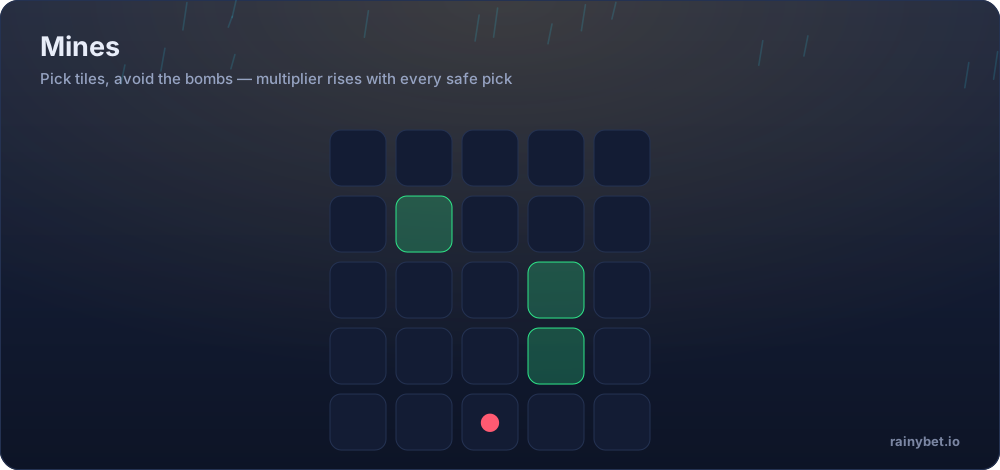
Difficulty tiers are not unique to this one title — they are a standard way tiered-risk originals let a player choose their own variance. A higher tier raises both the multiplier ceiling and the chance any single lane ends the round, which is the same trade-off Mines' bomb count and Plinko's risk setting make in their own formats.
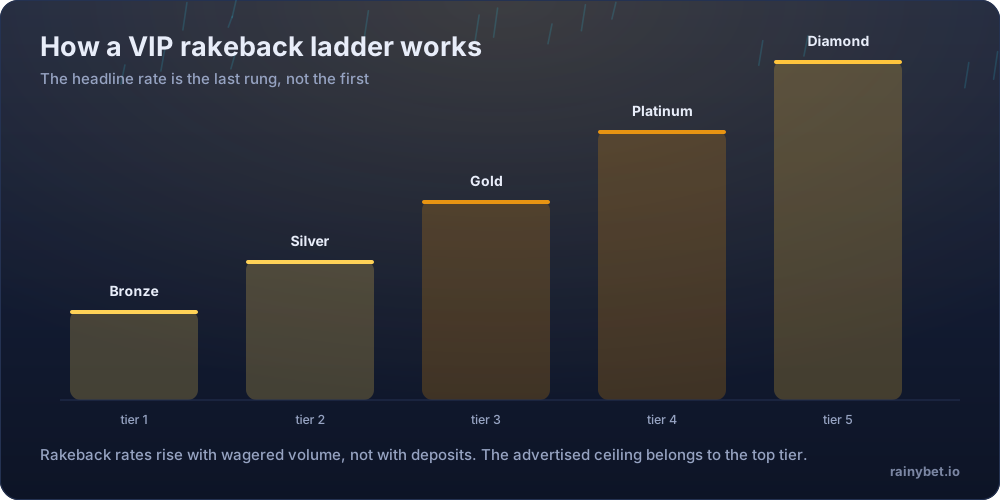
A beginner mistake is treating a higher tier as 'more skill required' rather than what it actually is: a variance dial. Choosing the top tier does not make you a better player, and it does not make the game more beatable — it just makes each session swing harder in both directions.
Cash-out discipline: the part that actually decides sessions
Because each lane is a visible, separate decision, the temptation to cross 'just one more' is stronger here than in a single continuous curve like Crash. The multiplier sitting right there, one lane before your planned stop, is designed to feel like it is asking a question. It is not — it is exactly the same bet you already decided against.
Decide before the round starts, not during it
Pick your target lane before you place the bet, out loud if it helps. A target chosen mid-round, after watching the multiplier climb, is almost always higher than the target you would have picked in advance — and that gap is where most losing sessions come from.
Provably fair verification on this game
Each round's lane outcomes are derived from a server seed committed before you bet and revealed afterward. Rotate your client seed, play a round, then reveal and re-hash the server seed to confirm nothing changed after your wager was placed. Full steps: Roobet provably fair guide.
Playing your first round, step by step
Four steps, and the second-to-last is the one that actually matters
- Pick a difficulty tier and a target lane count before you place any bet.
Where people trip up: Write the target down, mentally or literally, so the round cannot talk you out of it once the multiplier starts climbing.
- Register at Roobet with
ROOSPINSattached if you want the seven-day cashback running. Open the Roobet signup pageWhere people trip up: Add the code during registration — it is almost always signup-only afterward.
- Place a small stake for your first few rounds regardless of your usual bankroll size.
Where people trip up: Learning how a tier actually feels in real time is worth more than the extra stake size on early rounds.
- Stop at your pre-decided lane every single round for a fixed session, even on rounds that feel like they have more room.
Where people trip up: The discipline is the entire skill here — the lane outcomes themselves are provably fair and outside your control either way.
ROOSPINS and Mission Uncrossable
This is a lower round-per-minute game than Crash or Plinko, which changes how quickly turnover builds during the seven-day cashback window. Weighting for cashback is not published as fixed here — confirm before assuming it counts the same as faster-paced titles.
Bonus terms in one table
| Term | What applies |
|---|---|
| Bonus code | ROOSPINS |
| What the code unlocks | 20% Cashback for 7 Days |
| Offer type | Time-boxed cashback |
| Minimum qualifying deposit | Set in the cashier — shown at deposit |
| Wagering requirement | Set out in the operator’s bonus terms |
| Maximum bet while bonus is active | Defined in the bonus terms — check before staking up |
| Bonus validity window | Stated on the promotion page at activation |
| Game weighting | Published in the operator’s weighting table |
| Maximum cashout from bonus funds | Capped per the bonus terms where a cap applies |
| Sticky or non-sticky | Declared in the bonus terms per offer |
Fine print specific to this game
The small print on Roobet — read this part twice
- Higher difficulty tiers are a variance choice, not a skill signal. They redistribute risk and reward; they do not make the game more beatable.
- A target chosen mid-round tends to be riskier than one chosen in advance. Decide the lane count before you bet, not while watching the multiplier climb.
- Maximum bet is not a fixed published figure. Confirm the live limit before a large stake.
- Published edge figures are not fixed for this title. Provably fair verification confirms fairness independently of the exact number.
- Cashback rewards net loss over the window, not lanes crossed. A session of small wins offset by one large loss returns less cashback than the loss size alone might suggest.
Terms are the operator’s to change. If a clause below no longer matches what you see in your account, the account version wins — and we want to hear about it.
Honest pros and cons
What works about Roobet
- Discrete lane-by-lane format makes the decision points easier to see than a smooth curve
- Difficulty tiers give genuine, visible control over session variance
- Provably fair verification is straightforward on a step-based format
- A distinctive format compared with the industry-standard Crash and Mines templates
What to weigh up first
- The visible 'one more lane' temptation is stronger than in continuous rising-multiplier games
- Higher tiers are easy to mistake for a skill signal rather than a variance dial
- Maximum bet is not a fixed published figure — check the bet slip for the live limit
- Published house edge for the title is not a fixed, quotable figure here
Who this game actually suits
Suits players who want visible, discrete decision points and are willing to commit to a target lane before a round starts. Less suited to anyone who tends to renegotiate a stop-loss mid-session — the step-by-step format makes that renegotiation feel more justified than it actually is.
Licence, geo-restrictions and playing safely
Licensing. Access is blocked in a number of countries and US states, and the list is maintained by the operator rather than published as a stable document. The current restricted list and licence details live on the operator’s own terms page — read them before you register.
Your side of it. Crypto casinos settle fast, which is exactly what makes them easy to overplay. Before your first deposit at Roobet, set a deposit cap and a session timer in the account settings — not in your head.
- Deposit limits and self-exclusion tools live in account settings, not support chat
- A losing session is not a signal to raise the stake — it is a signal to stop
- Bonus turnover targets are not a reason to keep playing past your limit
- Free, confidential help: BeGambleAware and Gambling Therapy
Frequently asked questions
What is Mission Uncrossable on Roobet?
A house-made Roobet Original built around a crossing-lane format: you advance across a series of lanes, each with a chance of ending the round, and the multiplier rises with every lane you clear.
How is Mission Uncrossable different from Crash?
Crash gives you one continuous rising multiplier and one cash-out decision. Mission Uncrossable breaks the same idea into discrete steps — each lane is its own decision point, rather than one smooth curve.
What do difficulty tiers change in Mission Uncrossable?
Higher difficulty tiers raise the multiplier ceiling and the chance a given lane ends the round, mirroring how risk settings work across most tiered-difficulty Originals.
Is Mission Uncrossable provably fair?
Yes. Each round's outcomes are derived from a server seed committed before you play and revealed afterward, so you can verify nothing changed once your bet was placed. See our Roobet provably fair guide.
What is the house edge on Mission Uncrossable?
Roobet does not publish a single fixed edge figure for this game that we can quote here. Difficulty tier changes shift variance regardless of the exact edge number.
What is the biggest beginner mistake on this game?
Advancing one more lane after already deciding to stop, purely because the multiplier looked close to a round number. Cash-out discipline — sticking to a decision made before the round — matters more here than in most Originals.
Does ROOSPINS cashback apply to Mission Uncrossable?
Game weighting for cashback is not published as a fixed table. Confirm in your account before assuming volume on this title counts the same as others.