

On this page (6 sections)
Dice as an Originals RTP question
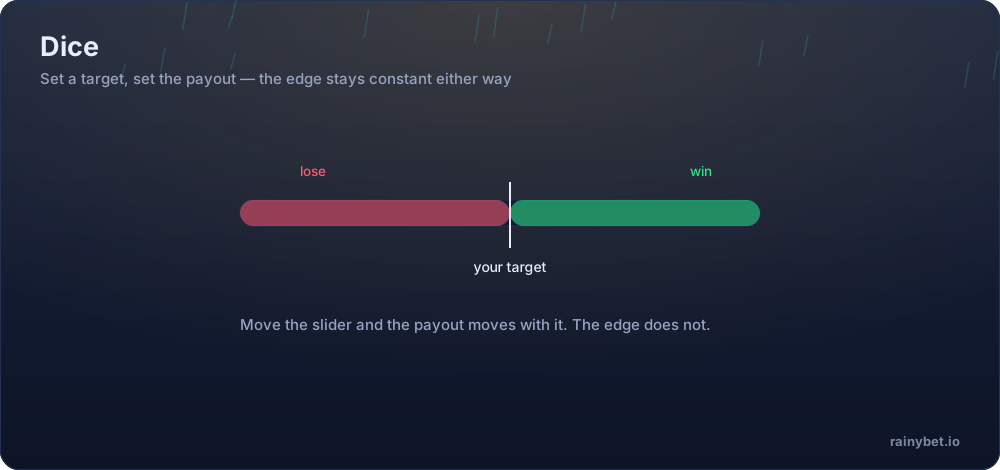
Dice is a roll-under casino original: a player sets a target between 1 and 98, and wins if a random roll between 0 and 100 lands below it, with a payout multiplier that scales inversely with the target chosen.
Reel slots hide their weighting behind a paytable and a published RTP figure. Dice is the opposite case: its entire payout mechanic is one formula that fits on a single line, which makes it the clearest possible illustration of what 'RTP' actually depends on.
The formula behind the payout multiplier
Roll a random number between 0 and 100 and win if it lands below your chosen target. Win chance is the target itself, expressed as a percentage. The payout multiplier is:
multiplier = (100 − edge) / target
Both edge and target are percentages. A target of 50 with a 1% edge gives a multiplier of 99/50 = 1.98x. A target of 10 with the same edge gives 99/10 = 9.9x — a much bigger payout for a much rarer win.
The algebraic proof the target cancels out
Expected return per unit staked is win chance multiplied by payout: (target/100) × (100−edge)/target = (100−edge)/100 = 1 − edge/100. Target cancels out of the final answer completely — it algebraically cannot appear in your expected value, whatever number you set it to.
Why moving the target never touches the edge
Drag the target from 5 to 95 and the win-chance and multiplier readouts swap places completely — a rare, large win becomes a frequent, small one. What never changes is their product. That's the cleanest demonstration on this site of the difference between variance (how spread out outcomes are) and house edge (the fixed average cost of playing), because the formula isolates the two so completely.
The live edge isn't a number we can quote
The formula above is public and exact. The specific edge parameter any given operator runs live is not published as a fixed, quotable figure — check the game's provably fair verification for the number in play. Whatever that number is, moving the target slider never changes it — only your bankroll's realistic size for the variance you're choosing changes.
What decides the effective RTP here
| Factor | Who controls it | What it changes |
|---|---|---|
| Target position | Player, set before each roll | Win frequency versus payout size — variance, not the edge |
| Bet size | Player | How much turnover you generate and how fast your bankroll can swing |
| Edge parameter | Operator, fixed and not published as a quotable figure | The actual expected return of every possible target |
This is the same fixed-edge principle behind Crash's bust-point distribution and Mines' combinatorial multiplier — Dice just makes it visible in a single algebraic step instead of a distribution or a running product.
Test it yourself before wagering anything
Our Dice simulator runs this exact formula with a live target slider, an adjustable house-edge input and a 1,000-roll batch mode, so you can prove the target-independence of the edge across a realistic sample size before wagering anything real.
Licence, geo-restrictions and playing safely
Licensing. Access is blocked in a number of countries and US states, and the list is maintained by the operator rather than published as a stable document. The current restricted list and licence details live on the operator’s own terms page — read them before you register.
Your side of it. Crypto casinos settle fast, which is exactly what makes them easy to overplay. Before your first deposit at Rainbet, set a deposit cap and a session timer in the account settings — not in your head.
- Deposit limits and self-exclusion tools live in account settings, not support chat
- A losing session is not a signal to raise the stake — it is a signal to stop
- Bonus turnover targets are not a reason to keep playing past your limit
- Free, confidential help: BeGambleAware and Gambling Therapy
Frequently asked questions
Is Dice a slot?
No — Dice is a casino original built around a roll-under target, not spinning reels. We cover its RTP here because readers researching 'slot RTP' are often asking a broader question about any RNG casino game's odds, and Dice's payout formula is the clearest of any Original on this site.
What is the Dice payout formula?
Multiplier equals (100 − edge) / target, where target is the roll-under number expressed as a percentage and edge is the fixed house-edge parameter. Win chance equals the target itself, so the formula guarantees the same expected value at every possible target.
Does moving the target slider change my RTP?
No. It changes win frequency and payout size in opposite directions — a low target wins rarely for a big payout, a high target wins often for a small one — while the expected value stays fixed at whatever the edge parameter sets it to.
What is the published house edge for Dice?
Operators generally don't publish a single fixed edge figure for Dice that we can quote here — check the game's own info panel or provably fair verification for the live number. The formula connecting target, edge and payout is public maths; the exact live edge at any specific operator is not.
Why is Dice considered the most transparent casino Original?
Because its entire payout mechanic is one visible ratio: win chance in, multiplier out, edge as the only adjustable constant. Mines, Crash and Plinko encode the same underlying principle in less directly visible ways; Dice is the one where the whole formula fits on one line.
Is Dice provably fair?
Yes, at most crypto casinos. The roll outcome is derived from a server seed committed before the bet and revealed afterward, so it can be independently verified. See our provably fair explainer for the general verification method.
Can I test different targets without risking real money?
Yes. Our Dice simulator runs this exact formula with a house-edge input and a 1,000-roll batch mode, so you can prove the target-independence of the edge for yourself before wagering anything real.